

The interesting news in 3D this year is not about one engine or one release. It is about plumbing: which file a brand can hand to a marketplace and trust it to open, what runs inside a browser with no app to install, and what an AI generator can and cannot pass to a production pipeline.
Six things genuinely changed between late 2025 and the middle of 2026. Each one below comes with a date and a source, plus what it means for a company that sells physical products rather than builds games. If you are looking for the wider commercial picture instead, we covered that separately in ecommerce trends and the future of ecommerce.
What is in this article
- AI 3D generation grew up and still cannot hand you a product model
- OpenUSD finally has a written specification
- WebGPU now ships in every major browser
- Gaussian splatting is turning into a file you can ship
- Unreal Engine 5.7 and Blender 5.0 landed a week apart
- The headset market restarted around Android XR
- 3D modeling news FAQ
#1. AI 3D generation grew up and still cannot hand you a product model

Start with the honest one, because it is the question behind most of the traffic this topic gets. In the US, ai 3d modeling is searched roughly 2,400 times a month, and every result on the first page is a generator rather than an article: Meshy, Spline, Canva, Hyper3D Rodin, 3D AI Studio. Two years ago that page was full of explainers asking whether the technology would work at all. That argument is over.
What the generators are genuinely good at now: turning a sentence or a photo into a recognisable shape in under a minute, filling a mood board, blocking out a scene, producing background props that nobody will inspect. For concept work this is a real change and it is not going backwards.
What they still do not produce is a model you can put on a product page. A generated mesh comes out as dense triangles rather than clean quad topology, with UV maps broken into fragments, no separation into parts, and no relationship to the real dimensions of the object. Four things a commercial model has to satisfy, and a generator currently satisfies none of them reliably:
- correct measurements, because a customer will hold the product up against a doorway or a shelf
- parts that exist separately, so a configurator can swap a finish or an animation can open a lid
- materials that behave under any lighting rather than a texture baked from one angle
- a mesh clean enough to export to glTF or USDZ without falling apart in the viewer
That is not a prediction about the future, it is where the tools are in the middle of 2026, and it is why our own pipeline uses AI for reference and iteration and not for the deliverable. If you want the fuller version of the argument, what 3D modeling actually involves covers the steps a generator skips, and 3D product modeling services describes what comes out at the end.
#2. OpenUSD finally has a written specification

The most consequential news of the year is the least exciting to look at. On 17 December 2025 the Alliance for OpenUSD published Core Specification 1.0, the first formal written standard for OpenUSD, the scene format Pixar released and the rest of the industry adopted.
It adds no features. What it does is define the minimum behaviour a piece of software must implement before it can claim to support OpenUSD, including the rules for syntax, composition and deterministic value resolution. Until now every implementation interpreted the format slightly differently, which is exactly why a file that looked right in one program arrived broken in the next. Steve May, chair of the alliance and chief technology officer at Pixar, described it as the first step toward ISO standardisation. Version 1.1, planned during 2026, adds animation and handling for very large scenes.
Why a brand should care about a specification document: interoperability is the thing that quietly costs you money. The model your studio builds has to open correctly in the marketplace viewer, in the AR build, in the configurator and in whatever your agency uses three years from now. A written standard is what makes that a reasonable expectation rather than a hope. Related reading on our side: 3D modeling standards for product models.
#3. WebGPU now ships in every major browser

WebGPU is the successor to WebGL, the technology that lets a browser talk to the graphics card properly. Chrome and Edge shipped it in 2023 and then it sat there, half supported, for two years. That ended quietly: Firefox 141 brought it to Windows in July 2025, Firefox 145 added Apple Silicon Macs, and Safari 26 shipped it across macOS Tahoe 26, iOS 26, iPadOS 26 and visionOS 26. As of late 2025 WebGPU ships by default in Chrome, Edge, Firefox and Safari, with Linux expected during 2026.
In plain terms, an interactive 3D model on a product page is no longer a compromise. No app to install, no plugin, no separate mobile experience that only half works. A 360 spin, a configurator or a viewer that hands off to AR on the phone can now be built once and be expected to run for nearly everyone who visits.
This is the change with the most direct commercial consequence in the list, and it is the reason interactive product pages stopped being an enterprise-only line item. See 3D product visualizer development and what a 3D configurator does to conversion.
#4. Gaussian splatting is turning into a file you can ship

Gaussian splatting is the capture technique that took over research in 2024 and production in 2025. Instead of building geometry, it records a scene as millions of coloured blobs, and the result renders in real time in a browser and looks like a photograph because it effectively is one.
The news is that it is becoming a shippable file. On 3 February 2026 the Khronos Group announced KHR_gaussian_splatting, an extension that stores splats inside glTF 2.0, the format most web viewers already speak. It is a release candidate rather than a finished standard, published for industry feedback, with ratification expected in the second quarter of 2026.
Worth being clear about what splats do and do not replace. A splat is a recording. You cannot recolour it, swap a finish, take it apart, drop it onto a white background or animate it opening, because none of that information exists in a recording. For a showroom, a property or a one-off capture it is superb. For a catalogue where every product needs six consistent angles, colourways and a configurator, it is the wrong tool and a built model is still the answer. Both will sit side by side, and knowing which job needs which is the useful skill. Compare with 360 product photography and photorealistic rendering.
#5. Unreal Engine 5.7 and Blender 5.0 landed a week apart

Two releases in November 2025 moved the tools most product visuals come out of.
Unreal Engine 5.7 promoted MegaLights from experimental to beta, which in practice means a scene can hold many more dynamic shadow-casting lights without the frame rate collapsing. Nanite Foliage arrived as an experimental path for dense vegetation, and both the Substrate material system and the PCG framework moved to production ready.
Blender 5.0 shipped on 18 November 2025 with full ACES colour pipeline support, HDR and wide gamut handling, new Volumes and SDF nodes in Geometry Nodes, and a more accurate subsurface scattering model that removes the darkening artefacts on skin, wax and thick plastics.
The commercial thread running through both is that real time keeps closing the gap with offline rendering. That matters because it is what allows a single asset to serve the catalogue photo, the product film and the interactive viewer instead of three separate builds. Background on the toolset is in the ten best 3D modeling programs and on the split between the two stages in 3D modeling versus rendering.
#6. The headset market restarted around Android XR
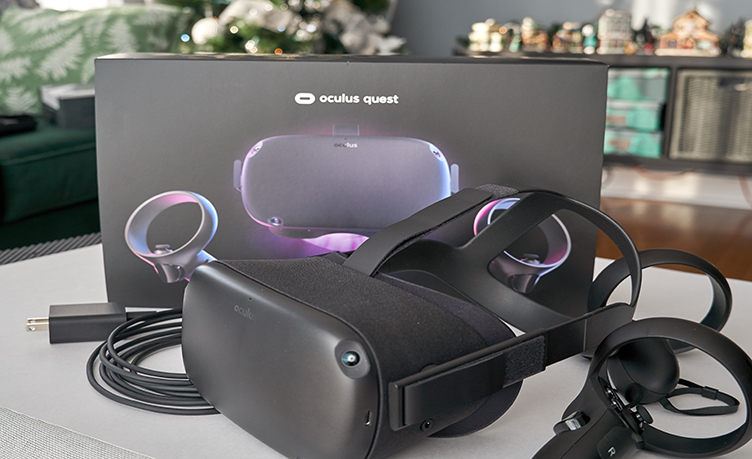
The old version of this article was excited about Oculus Quest. The headset story has since restarted somewhere else. On 21 October 2025 Samsung shipped Galaxy XR at 1,799.99 dollars, the first device built on Android XR, Google’s operating system for mixed reality.
Our honest read for product brands has not changed with the hardware. Headsets remain a small audience and a long bet. The augmented reality that actually sells furniture and appliances today runs on the phone already in the customer’s hand, through the browser or a marketplace app, and it needs the same thing it needed five years ago: a correctly scaled model with real materials. What a new platform changes is the number of places that model has to work, not whether you need one.
We laid out the practical side in AR product visualization, the business case in how AR helps ecommerce, and the difference between the two technologies in AR versus VR for online shopping.
Line the six up and a pattern appears. A written standard for the scene format, a graphics layer in every browser, a capture format heading for ratification, two engines closing on offline quality, a new headset platform, and generators that produce shapes but not deliverables. Formats and viewers are churning fast. The thing that stays put is the model itself, built to real dimensions with parts that separate, because that is the asset every one of those channels consumes.
Which is the argument for building it once and properly rather than re-shooting for each new format. If you want to see what that looks like on a product, our 3D product rendering services and seven formats of product visuals are the practical starting points, and 3D modeling services is where a project usually begins.
3D modeling news FAQ

Catherine Paul
Content Writer, Editor
Catherine is a content writer and editor. In her articles, she explains how CGI is transforming the world of architecture and design. Outside of office, she enjoys yoga, travelling, and watching horrors.
Let us know if you’ve got an interesting project and want to work together!