
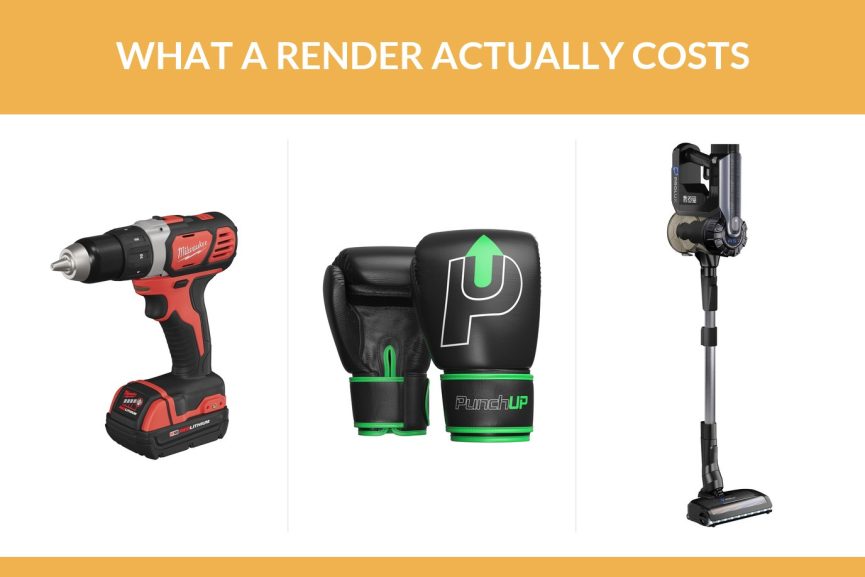
Ask five studios what a product render costs and you will get numbers between 30 dollars and 900, for what sounds like the same picture. Nobody is lying. They are quoting different things, and the difference is almost never the image.
This page gives the numbers first: what we charge, what the market publishes, and why the two sit so far apart. Then the part you actually came for, which is how to pay less without ending up with a worse picture.
Contents
The short answer, in numbers
A silo image of a product on white, rendered from a model that already exists, is about 20 USD. Run a whole catalogue as one batch and the per image price falls to about 1 USD. Put the product in a built scene and it starts at 120 USD. A full set for one product, model included, starts at 360 USD.
If you have no 3D model yet, add the model: from 80 USD for a simple part, around 200 for a typical product, about 400 for a complex one. That single line is what most of the confusion is about, and the rest of this page explains why.
What we charge
Everything is billed at 20 USD per hour, and two rounds of revisions are included. These are the starting prices from our 3D product rendering services.
| What you order | Price | Delivery | What that covers |
|---|---|---|---|
| A silo image on white | from 1 USD | 1 to 2 days | One angle, product only, ready for a shop page or a marketplace. A single shot is around 20. Across a catalogue run as one batch it falls to about a dollar an image. |
| An image with a scene | from 120 USD | 2 to 3 days | A simple set starts there. A full environment built from scratch is quoted by the hour. |
| A new finish or colourway | from 60 USD | same set | A colour, fabric or print applied to a model you already have. |
| A full set for one product | from 360 USD | 3 to 5 days | The model, the finishes and the renders, quoted as one project. |
What the market publishes
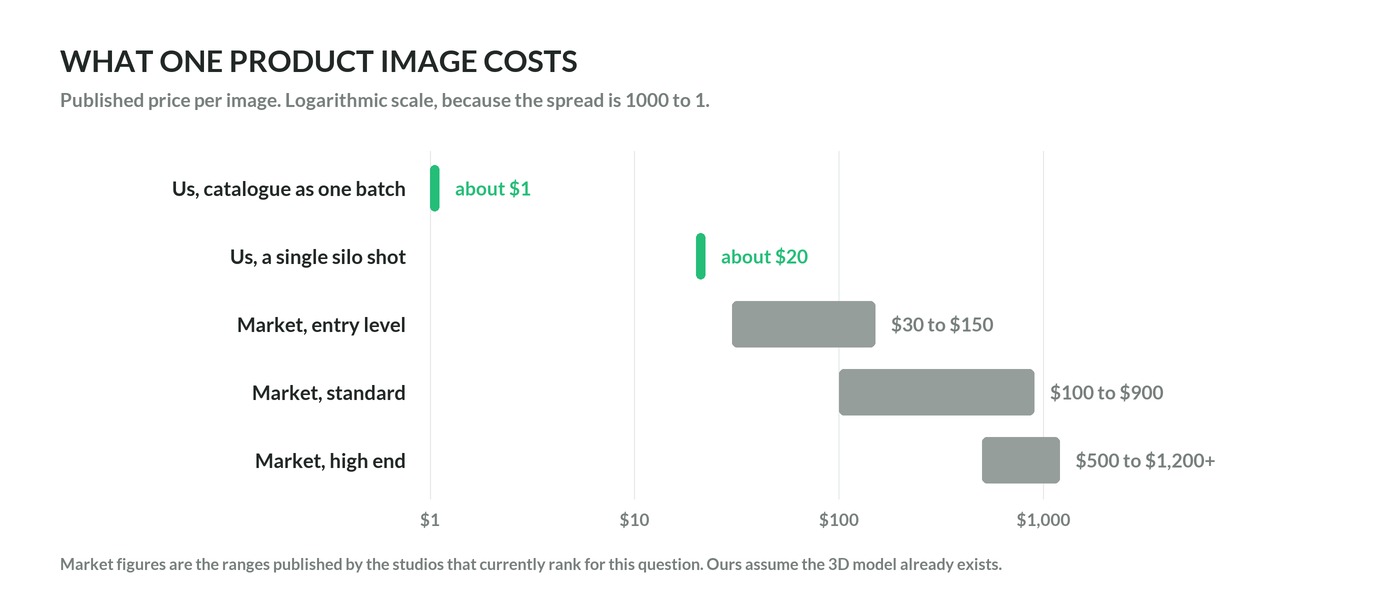
Here is what the published cost guides say, gathered from the pages that currently rank for this question. The numbers are per image.
| What is being quoted | Published range per image | What sits behind the number |
|---|---|---|
| A product still, entry level | 30 to 150 USD | Simple geometry, plain background, little post work. |
| A product still, standard | 100 to 900 USD | The band most product studios publish. One guide puts around 80 per cent of visualization studios between 450 and 800. |
| A product still, high end | 500 to 1,200 USD and up | Advanced lighting, complex materials, heavy retouching. |
| An interior or exterior image | 600 to 4,000 USD | Architectural work, priced per view. Not a product price, though it is often quoted on the same page. |
Why the two tables disagree by 100 times
Three reasons, and none of them is that somebody renders better.
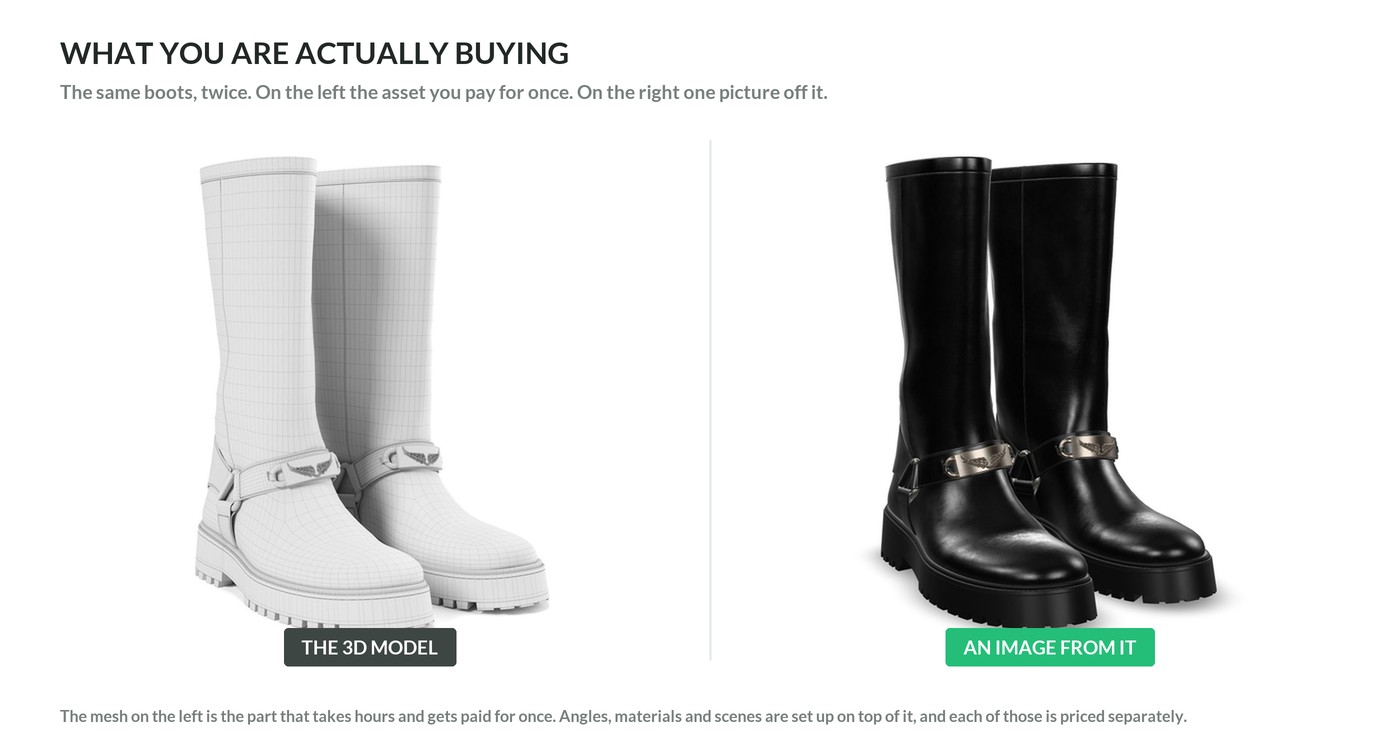
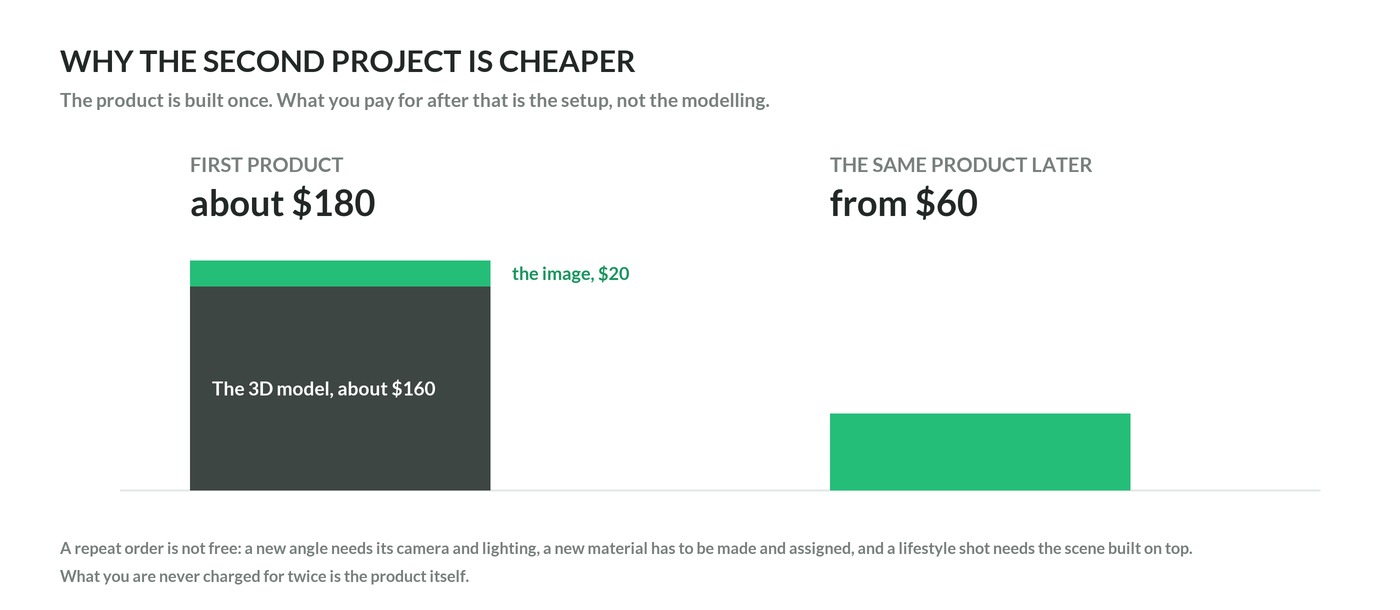
Most published prices include the model. When a guide says a product render is 400 dollars, it usually means building the product in 3D and then photographing it. Building it is the expensive half, and it happens once. Our 20 dollar silo assumes the model is already there, which after the first project it is.
Half the cost guides are written by architectural studios. An exterior view is a building, a street, vegetation, sky and light study. Six hundred to four thousand dollars is a fair price for that and has nothing to do with a kettle on white.
Volume changes the unit price completely. One scene, one lighting setup, one camera, and then two hundred products through it. The setup is paid once. This is why a catalogue lands near a dollar an image while a single one off shot of the same product is twenty.
What actually moves a quote
| Factor | Cheap end | Expensive end |
|---|---|---|
| The model | You already have it, or you send usable CAD | Built from photographs, many parts, fine detail |
| The background | White or a gradient | A built interior with props and custom lighting |
| Volume | A catalogue run as one batch | One image, ordered on its own |
| Materials | Plastic, painted metal, plain fabric | Glass, liquid, chrome, transparent packaging, fine print |
| Revisions | Notes at the draft render | Structural changes after final frames |
| Deadline | Normal schedule | Compressed, needs parallel artists |
Five ways to pay less
All five are things you control before the project starts. None of them costs you quality.
1. Order the catalogue, not the image. The single biggest lever on this page. Twenty images ordered one at a time and twenty images ordered as a batch are the same work for us in a different order, and only one of them is priced per setup.
2. Reuse the model instead of rebuilding it. A new angle, a colourway or a new material starts at 60 USD, because the product itself is already built.
Worth being precise about what that price buys, because “you already have the model” does not mean the next picture is free. A new angle still needs its camera and its lighting set up. A new material has to be made and assigned before it renders. And a lifestyle shot needs an environment that does not exist yet, which is why an image with a scene starts at 120 USD and a full environment is quoted by the hour rather than from a price list. What you are never charged for twice is the product itself, and on a real catalogue that is most of the money.
3. Approve the grey model before materials. The untextured model is the cheapest moment to change anything. A proportion fixed there is minutes. The same fix after texturing and lighting is a re-render of everything. This is the approval clients most often rush, and it is where budgets quietly leak.
4. Fix the shape once, at the brief. CAD if you have it, because it carries exact measurements. If not, photographs from several sides plus overall dimensions and material names. What costs money is not the absence of CAD, it is discovering on day four that the product has a detail nobody photographed.
5. Give notes at the draft, not after the final frames. Two rounds are included in our price. Both are useful if they arrive while the scene is still open. A structural note after final frames is a new render pass, and that is what turns an included revision into a line on the invoice.
What to send so the quote is accurate
A quote takes one business day and needs four things: the product, either as CAD or as photographs from several sides; overall dimensions; material names, because glass and brushed metal are not the same job as matte plastic; and where the images end up, because a marketplace has requirements a campaign does not. If the terms in this list are unfamiliar, what 3D modeling is covers them in plain words.
Two neighbouring numbers, if you are budgeting a whole project: the modelling side is broken down in 3D modeling price, and moving pictures are priced per second in 3D product animation cost. If you would rather see what the money buys, five projects with the client reference next to the finished renders are in product rendering examples.
FAQ
If you want a number rather than a range, send the product and a line about where the images have to end up. A quote comes back in one business day.

Ian Diev
Content Writer, Editor
Ian loves writing about innovative 3D technologies and their impact on architecture and design. In his spare time, he makes indie music, watches obscure movies, and cooks culinary masterpieces for friends.