
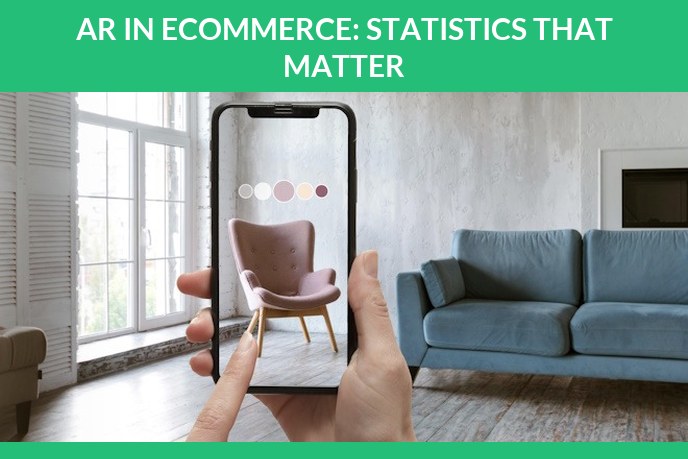
What is on this page
Every pitch deck about augmented reality quotes statistics, and most of them travel far from their sources. This page collects the AR shopping numbers that can actually be traced to a named study or a named brand, with the source stated next to every figure. We keep it updated as new data appears, and we say openly where a number comes from a platform with something to sell. If you are here deciding whether to add AR to your own store, the practical side, formats, examples and prices, lives on our AR product visualization page.
How many people shop with AR
- More than 100 million consumers already shop with AR online and in stores, according to the Deloitte Digital and Snap consumer AR report based on a survey of 15,000 consumers.
- In the same study, nearly three quarters of consumers said they expect their use of AR to increase over the next five years.
AR and conversion
- Interactions with products that have 3D or AR content showed a 94 percent higher conversion rate than products without, per Shopify from its own platform data.
- In the Rebecca Minkoff case published by Shopify, shoppers who viewed a product in AR were 65 percent more likely to buy, and those who interacted with a 3D model were 44 percent more likely to add to cart and 27 percent more likely to place the order.
- Gunner, a manufacturer of heavy duty dog kennels, reported a 40 percent rise in order conversions after adding 3D and AR to its product pages.
AR and returns
- Snap reports that AR-guided purchases led to a 25 percent decrease in returns, as covered by Retail Dive.
- The same Gunner case that saw conversions rise also recorded 5 percent fewer returns.
- For context on why this matters: US retail returns run at 15.8 percent of annual sales overall and 19.3 percent online per the National Retail Federation, so roughly one online order in five comes back.
How to read these numbers
Two honest caveats. First, the loudest figures come from platforms that sell AR tooling, Shopify and Snap included, so treat exact percentages as directional rather than gospel. Second, the effect is real but it is not magic: AR helps most where the doubt it removes is real, products where size, fit or placement in a room decides the purchase. The mechanics of where AR actually earns its keep are unpacked in our AR in ecommerce guide, and the AR-against-VR question is settled in AR vs VR.
Getting AR onto your product pages
Everything in these statistics runs on one asset: a 3D model of the product exported to GLB for Android and the web and USDZ for iOS. No app is required, the viewer is built into the phone. At UFO3D the model of a typical product costs about 200 USD, AR-ready export included, with work billed at 20 USD per hour and two revision rounds. Details and examples are on our augmented reality product visualization page, and the modeling itself is part of product 3D modeling services.

This is the kind of asset the statistics run on. Drag to rotate the bike, and on a phone scan the QR code or tap the AR icon to see it in your space at real size.
FAQ

Ana Wayne
Content Writer, Copywriter
Ana is a content writer for UFO3D. She has a passion for exploring tech innovations and product marketing trends – and for writing about them. Outside of work, she is a fan of sci-fi movies and a street food connoisseur.