
Contents
- Why published quotes disagree by a factor of 500
- Why we price per second, not per minute
- Our rates
- What common lengths come to
- The five things that move a quote
- The largest line that is on no price list
- What to send so the quote is accurate
- Where budgets actually leak
- Can you do it for free
- Frequently asked questions
Ask what 3D animation costs and the internet answers with a range so wide it is useless. This page explains what sits behind that range, publishes our own numbers, and lists what actually moves a quote up or down.
Why published quotes disagree by a factor of 500
Two current price guides, both credible, both talking about 3D animation. Twine, a freelancer marketplace, puts 3D work at 100 to 3,000 dollars a finished minute depending on complexity. Vidico, a video production company, puts 3D animation at 5,000 to 50,000 dollars a finished minute. The gap between the bottom of one and the top of the other is 500 times.
| Who is quoting | Published range, per finished minute | What you get |
|---|---|---|
| DIY and AI tools | 0 to 500 dollars | Templates. No product accuracy. |
| Freelancers | 1,000 to 5,000 dollars | One person, one skill set, no cover if they are ill |
| Small and mid studios | 5,000 to 15,000 dollars | Modelling, animation and post under one roof |
| Full service companies | 15,000 to 50,000 dollars and up | Strategy, scripting, voice, music, campaign delivery |
Tiers and ranges as published by Vidico, 2026.
Neither guide is lying. They are describing different products under one name. A turntable of a model you already own and a sixty second launch film with simulation and a sound design pass are both called 3D animation, and one of them costs a hundred times the other.
If you have not settled on a format yet, prices will not mean much. Our guide to product animation walks through the six types and what each one proves, and the numbers below make more sense once you know which one you are buying.
Why we price per second, not per minute
A per minute rate hides the thing you control. Almost nobody orders a minute. Product films are ten, fifteen, thirty seconds, and the cost tracks the length of the script far more closely than any hourly estimate. So we quote per second of finished film, which means you can do the arithmetic yourself before you contact anybody.
The one exception is effects work, and it is worth understanding why.
Water and particle simulation. Shots like this are quoted from the script rather than by the second.
Water, smoke, powder, particles and destruction are simulated rather than animated by hand. The machine has to solve the physics before a single frame is rendered, and that solve does not get cheaper because the shot is short. A four second simulation can cost more than thirty seconds of straightforward camera work, which is why these are priced from the script.
Our rates
| Type of film | Price | What it covers |
|---|---|---|
| Installation and how to films | 30 dollars per second | Assembly, setup, maintenance, repair. Camera work with callouts. |
| Standard product animation | 60 dollars per second | Launch films, product page loops, scenes with props and lighting. Animation, render and grade. |
| Effects heavy shots | Quoted per project | Water, smoke, powder, particles, destruction. |
In practice a fifteen second product page loop lands around 900 dollars and a thirty second launch film around 1,800. Two rounds of revisions are included. Delivery is two to four weeks for a launch film and a few days for a short loop. If the 3D model does not exist yet, the modelling is quoted on top, and that is the part worth reading about below.
That puts us between the freelancer tier and the studio tier in the table above, which is a deliberate position rather than a discount. The full list is on 3D product animation services.
What common lengths come to
Per second pricing is easy to convert, so here are the three lengths clients ask about most. These assume a model already exists or arrives as usable CAD.
| Length | Standard product animation | Installation or how to film |
|---|---|---|
| 15 seconds | about 900 USD | about 450 USD |
| 30 seconds | about 1,800 USD | about 900 USD |
| 60 seconds | about 3,600 USD | about 1,800 USD |
Two rounds of changes are included at every length. What is not included is building the product from scratch when no drawings exist, which is the line covered further down.
The five things that move a quote
| Factor | Cheap end | Expensive end |
|---|---|---|
| The model | You send usable CAD | Built from photographs, many materials, fine detail |
| The scene | White or gradient background | Full interior with props, custom lighting |
| Length | Ten to fifteen seconds | Sixty seconds and beyond |
| Revisions | Notes given at the animatic | Structural changes after final frames |
| Deadline | Normal schedule | Compressed, needs parallel artists |
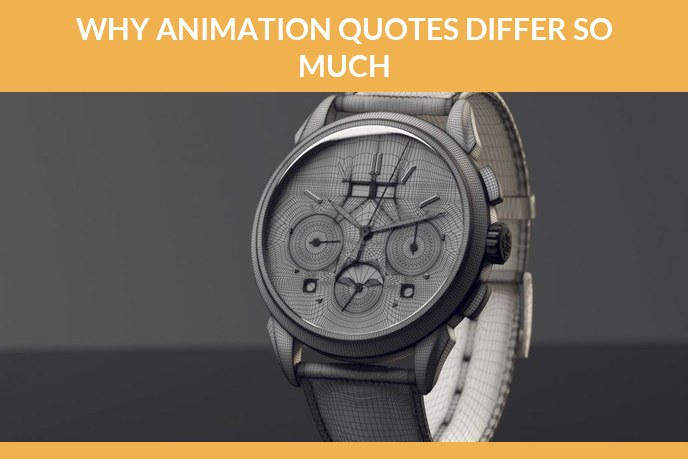
- The model. Polygon count, how many separate materials it needs, and how much fine geometry the product has. A stool is not a wristwatch.
- The scene. A product on white is a lighting setup. A product in a styled kitchen is a room that has to be built. A library scene we already own sits in between and is the usual way to keep this line down.
- Length. Directly proportional at our rates, which is exactly why we publish them per second.
- Revisions. Colour, camera position and pacing are cheap while the film is still grey. Changing the shape of the product or the structure of the script after rendering means redoing the work, and that is a new project rather than a correction.
- The deadline. A rush does not make the work smaller, it makes it parallel: more artists, overtime, render capacity pulled off other jobs.
An assembly loop like this one is an installation film: fixed camera, no simulation, nothing to solve before rendering. That is why it sits at the lower of the two rates above.
The largest line that is on no price list
Every published rate, ours included, assumes there is something to animate. If the product exists only as photographs or drawings, the model has to be built first, and on a single film that is routinely the biggest number in the quote.
Which is also why the second film is so much cheaper than the first. The model is an asset you keep. Once it exists it serves the cutaway, the assembly film, the still images on the listing and every future colourway, and none of those pay for the modelling again. If you expect to need more than one film, that changes which quote is actually the cheap one.
What to send so the quote is accurate
Most vague quotes are the result of a vague request. Six things, and a quote stops being a guess:
- What the film has to prove. One sentence. Not what the product is, but the objection the film has to remove.
- The product itself. CAD if it exists. If not, drawings, or photographs from several angles in even light, plus dimensions and material names.
- Length, resolution and format. These are direct multipliers, so leaving them open leaves the price open.
- A rough script or shot order. What the camera sees, in sequence. Two lines per shot is enough to price it.
- References. One film whose pace and tone you like, and one you do not, with a line on why. This single item removes more revision rounds than anything else.
- Post production needs. Voice over, music, subtitles, logo, captions in other languages. All of it is quoted separately and all of it is cheaper to plan than to add.
Where budgets actually leak
Not in the render. In the approvals.
A product animation is decided twice: at the storyboard, and at the animatic, the grey untextured version where the timing and the camera already exist but nothing is rendered. Anything changed at those two points is nearly free. The same change requested after final frames means the frames are thrown away.
The practical consequence is that the cheapest thing a client can do is look carefully and early at something that looks unfinished. Approving a grey animatic quickly because it is not pretty yet is the single most expensive habit in this business.
Can you do it for free
The software, yes. Blender is free and fully capable of everything described on this page, and the rest of the field, from Maya and Cinema 4D to Unreal, is compared in our guide to 3D animation software for product video. What is not free is the time: modelling a product accurately, building materials that survive close inspection, and rendering enough frames. The cost of 3D animation has never really been the licence.
For a simple turntable of a product you already have as a model, doing it in house is a reasonable decision. For a cutaway of a mechanism or anything with simulation, the learning curve costs more than the quote.
FAQ
If you want a real number rather than a range, send the product and a sentence on what the film has to prove. If you are still deciding between animation and a camera crew, product video for ecommerce compares the two, and animated product video covers which format fits which problem.

Ian Diev
Content Writer, Editor
Ian loves writing about innovative 3D technologies and their impact on architecture and design. In his spare time, he makes indie music, watches obscure movies, and cooks culinary masterpieces for friends.