About This Project
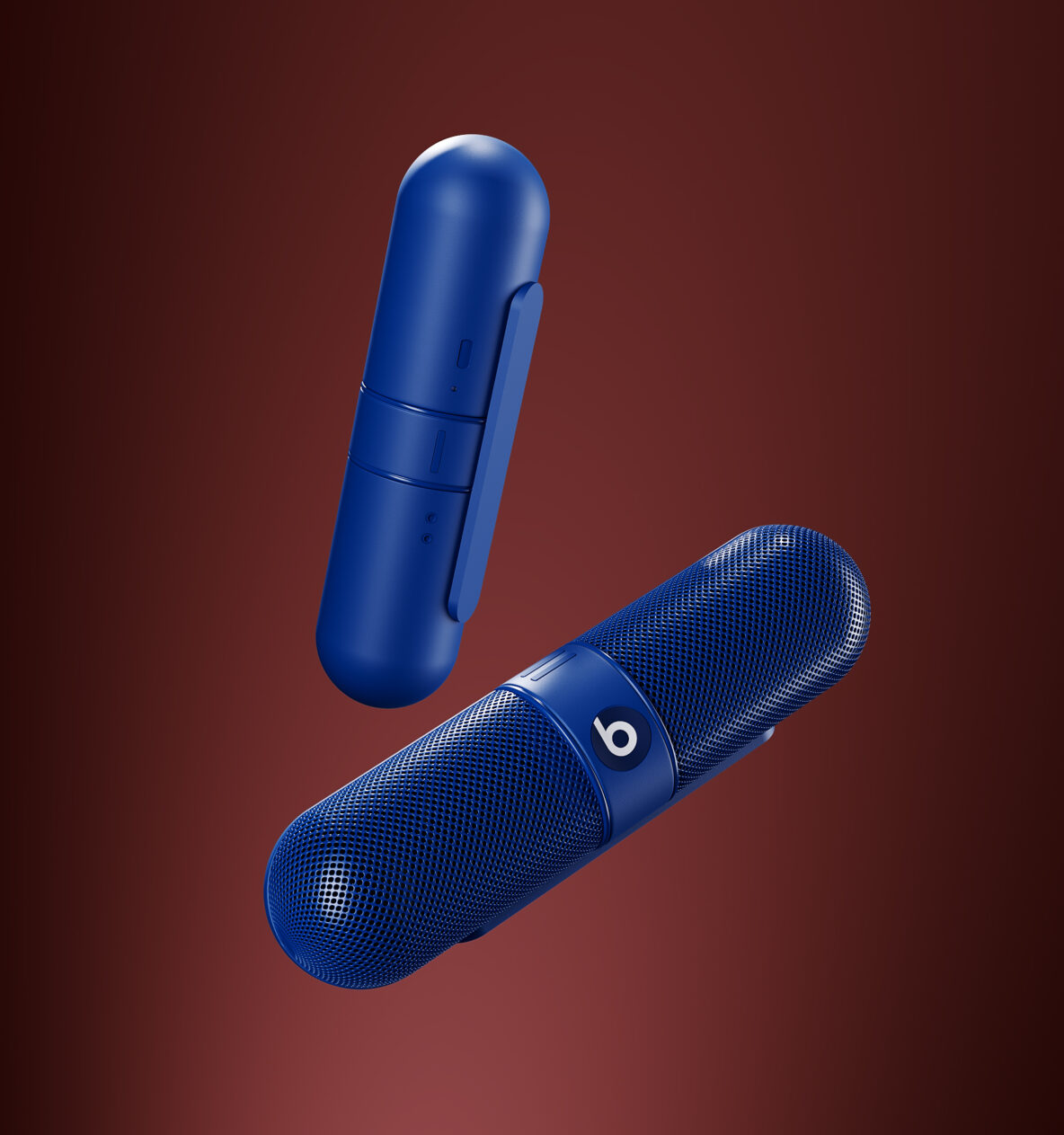
A blue wireless speaker shaped like a capsule. We show it twice, at two angles, hanging in the air in front of a dark red gradient. One stands nearly upright and the other’s tipped over at an angle. That way you see the end cap with the logo and also the long side of the body with its grille.
What was modeled
On paper it’s simple. A cylinder, rounded at both ends. It’s the small stuff that sells it as real. Rows of tiny perforations in the grille wrap right round the body. The end caps are their own part with a slightly different finish, and one of them has a small logo. You can see the seam where cap meets body, like you would on an actual moulded product. We modeled all of it to stay crisp at any size, thumbnail or full-width banner.
The finish
The blue is satin, not gloss. Gloss would mirror the whole room and you’d lose the shape. Satin doesn’t do that; it lets the curve of the body show through in smooth gradients of light. And the red behind it? That’s there to push the blue harder. They sit on opposite sides of the colour wheel.
Price and timing
Electronics projects run from about 360 USD for a small device to around 1,080 for something as complex as a drone. A portable speaker on a comparable project came to about 360 USD and three days. Work outside the package is billed at 20 USD an hour, and the grey model is approved before any finishing work starts. The full breakdown is on our electronics 3D modeling page.
Why a floating composition
Floating product shots turn up all over electronics ads. They feel light and modern, and there’s space left over for copy. Do that in a studio and you’re hanging the product on wires or stands, then retouching them out after. In 3D we just put the speakers wherever we want, any angle, no supports to clean up. Need it on white for the shop? Fine. A shelf or a picnic blanket for a lifestyle shot works too.
Small speakers get shown in use a lot: on a desk, tucked in a bag, next to a pool. Build each of those scenes once and you can drop in every colour in the range, so the campaign shows the whole line in matching settings.
The logo on the end cap is also worth a word. Small logos are where low-quality renders go soft or blurry. Here it is real geometry, slightly raised, so it stays readable in close-up and catches a thin highlight along its edges.
One model, a whole range
Speakers usually come in several colours. Each additional colour is a material change on the existing model, priced at 1 USD per colourway. The product page, the ads, the packaging render and next year’s colours all come from this one file. The model can also become a 360 spin, a short animation with the speaker turning and pulsing, or an AR file so a buyer can see its real size on a desk.
For a sense of how renders like this compare with studio photography on white, see our guide to white background product photography.
Let us know if you’ve got an interesting project and want to work together!