About This Project
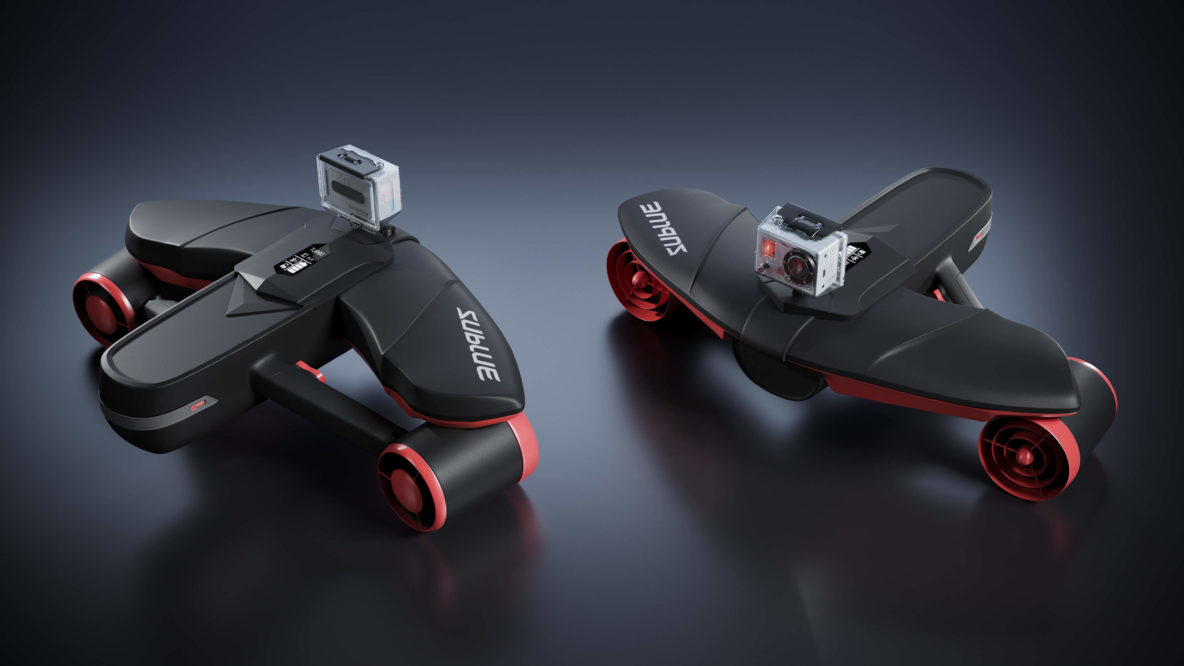
Two underwater scooters in black and red, each with an action camera mounted on top, rendered side by side on a dark studio set. The scooters are the kind of device a diver or snorkeller holds in front of them to be pulled through the water. The cameras turn them into filming rigs.
What was modeled
An underwater scooter has a body with handles on either side, propeller shrouds at the back, controls on the grip, and a mount on top. Here the mount carries an action camera, which is a small product in its own right, with a lens, buttons and a housing. The red details on the shrouds and handles were set up as a separate material from the black body, so the two-tone design reads clearly.
Price and timing
This underwater scooter came to about 720 USD and six days. It sits in the middle of our electronics range, which runs from about 360 USD for a small device, like a portable speaker, to around 1,080 for a drone. Work outside the package is billed at 20 USD an hour, and two rounds of changes are included. The details are on our electronics 3D modeling page.
The studio set
Dark backgrounds suit tech products with strong silhouettes. The scooters are lit so the edges of the body pick up highlights and the red details stand out. The reflective floor adds a soft second image of each scooter and gives the composition weight. Two units side by side, angled differently, show the product from two sides in one frame.
Why render a product meant for water
Photographing a product like this in its real setting means underwater photography: a pool or open water, a diver, special housings and a lot of luck with light. Even studio shots need the product to be finished and the camera mount fitted. A 3D model can show the product in a studio, in the water, or in an exploded view, before production units exist.
For a product with an accessory like the camera, the model also makes it easy to show different setups: with and without the camera, with a light mounted instead, or with the mount empty. Each setup is a matter of adding or hiding parts.
Products used outdoors or in water also need believable wear in some campaign images, a few drops, a little sand. Those details can be added to the model for a specific scene and removed again for the clean catalogue shots, without touching the base model.
What else the model can do
From the same model the brand can get silo shots on white for retailers, a 360 spin, an animation of the scooter moving through water, or an exploded view of the motor and battery. New colourways are a material change at 1 USD each. The model can also be exported for AR, so customers can see the size of the scooter before buying.
If you are planning a product video, our guide to product video for ecommerce explains which formats work where.
Let us know if you’ve got an interesting project and want to work together!