About This Project
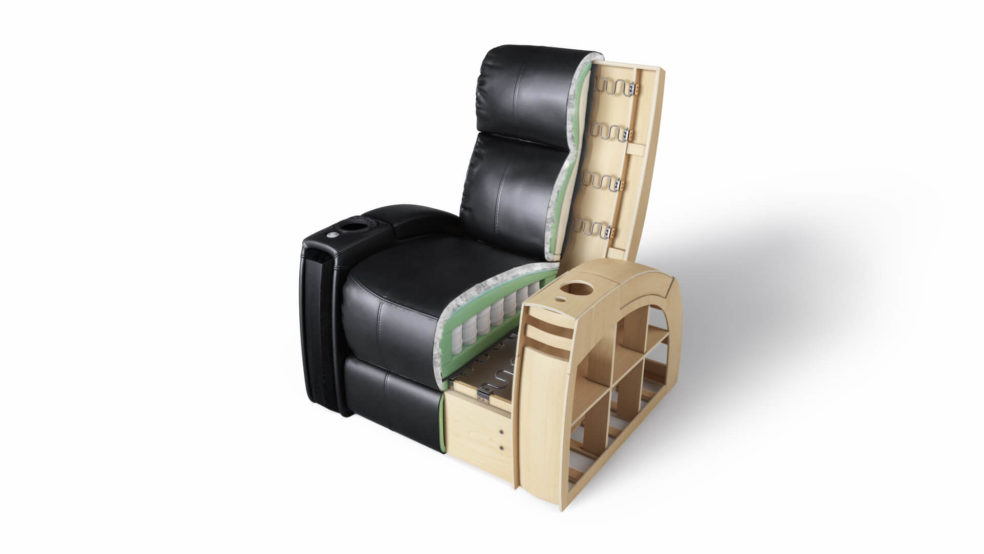
A leather home cinema recliner, cut open to show what a shopper never sees: the wooden frame inside the arms and back, and the layers of foam under the leather. The intact half of the chair shows the finished product, black leather with padded arms, while the cut half shows how it is built. The image is a single render on white.
Why a cutaway
People spending serious money on furniture want to know what they’re paying for. So they ask: is that frame real wood, or particle board? And how much foam is there, really? One cutaway picture settles it. With a camera you’d have to saw a finished chair in half, and the edges almost never come out clean. With a 3D model it’s just another render. The inside already exists in the file, so opening it up costs very little.
What was modeled
We built this chair in layers, because a cutaway falls apart if the inside is fake. On the outside, leather. It has grain, and it creases softly wherever it’s pulled tight over the padding. Below that you get foam, several layers, and each one is its own thickness. Then the wooden frame, joints and panels included. Look at the cut face and you can count the layers one by one. And the half that’s still whole? It has to line up with the open half perfectly, or people won’t read it as one chair.
Price and timing
We charge 20 USD an hour for furniture models, which means the part count sets the price. Something simple, say a stool or a side table, starts at about 80 USD. Most pieces land near 200. A sectional sofa costs more, and so does a fitted wardrobe with drawers and hardware. Expect three to five days per piece to model it and render it on white and in context, with two rounds of changes included. The full breakdown is on our furniture 3D modeling page.
The shot on white
Cutaways are usually shown on white, because the subject is technical and the background should not compete. The same model can also be rendered intact, in a home cinema room, from every angle, or in different leather colours.
Where cutaways are used
You can put a cutaway like this on a product page, right beside the regular images. It fits a catalogue spread about construction quality too, or a trade show panel, or a sales presentation for retailers. On social media it does well, since it shows something people are curious about and hardly ever get to see.
Sales teams get use out of it as well. A retailer who’s deciding whether to stock the chair sees the construction at a glance, and the same image can go straight into a buyer presentation or a line sheet.
What else the model can do
Want motion? The recliner can be animated: the footrest comes out, the back tips back, and you watch the mechanism work. Or turn it into a 360 spin. An AR file is another option, and then a customer can drop the chair into their own room to check whether it fits. Different leather colours and fabric options don’t need a new model, only new materials.
More on how furniture brands use renders instead of photo shoots is in our article on furniture rendering.
Let us know if you’ve got an interesting project and want to work together!