
About This Project
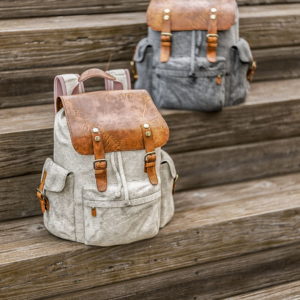
One backpack model, three looks. There’s a floral print on navy, then a purple geometric pattern, then plain light grey. We rendered each version on white from several angles (front and three-quarter), so they can go straight into a product listing.
Why colourways are where 3D pays for itself
Backpack ranges rarely launch in one print. Usually there are several prints and colours, and if you photograph them you need a physical sample of each one, a day in the studio and then retouching so the shots match. With 3D we build the geometry once. Panels, zips, pockets, straps, the handle. After that, every print or colour is just a material swap on the same file. A new colourway on an existing model costs 1 USD. It also comes out in exactly the same light, from exactly the same angle, as the others. Shoppers flick between variants on a category page, and they notice when one shot looks off. Here none of them do.
What was modeled
There’s a zipped front pocket, side pockets, a top handle and padded shoulder straps, plus a zip running all the way around the main compartment. A fabric bag isn’t a perfect geometric object. Soft goods bulge a little at the panels. Seams pull. Straps hang in a loose, natural curve. We modeled those small flaws on purpose. Why? A backpack that looks perfectly stiff starts to read like a plastic toy.
The prints
We apply each print as a material, and it has to wrap the bag the way a cutter would lay the fabric. The floral runs across the front without a break. The geometric print lines up with the seams, so it doesn’t snap off awkwardly at an edge. And the grey version? It shows the shape most clearly of the three. That’s one reason brands often keep a solid colour in a range like this, even when the prints sell better.
Price and timing
Fashion pieces typically start from about 780 USD and take six to ten days. Where you land depends on how much soft geometry and hardware the piece has. On a comparable project, a backpack in two colourways came to about 870 USD and six days. Once the model exists, each extra colourway is 1 USD. Anything outside the package is billed at 20 USD an hour, and two rounds of changes are included. You’ll find the full picture on our fashion 3D modeling page.
Marketplaces add a practical reason too. A lot of platforms want the same angles for every variant, and some will reject images if the framing drifts even slightly. One model, one camera setup, every colourway: the rules are met and nobody has to fiddle with crops afterwards.
What else the model can do
Silo images are only the start. The same backpack can be dropped into a lifestyle scene, say a city street or a classroom, with no model and no location. It can become a 360 spin on the product page, so a shopper can look at the pockets and the back panel. Or an AR file, to see it at real size. If you sell through marketplaces, it’s also easy to produce every image size and angle each platform asks for. We cover how fashion brands use this day to day in our article on clothes 3D modeling.
Let us know if you’ve got an interesting project and want to work together!