About This Project
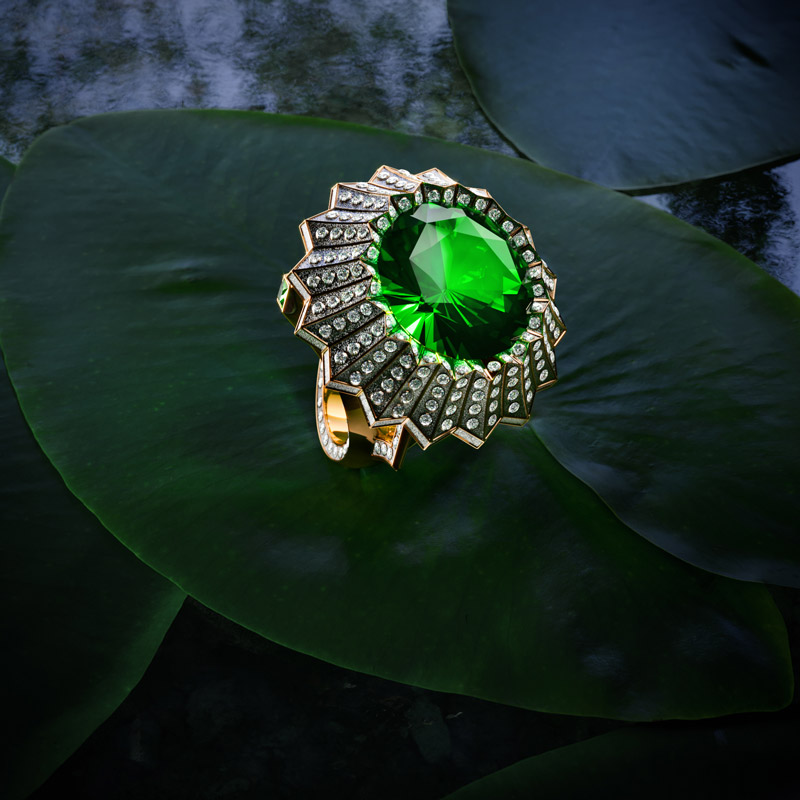
This one’s a cocktail ring with a large oval green stone, set high on claws. Small petals fan out around it and we paved each petal with tiny stones. The band is two-tone, so you get yellow gold on the shank and white metal up on the head. In a thumbnail it looks easy enough. Once you actually start building it, though, it turns into dozens of separate parts.
The modeling
Every stone in the setting got its own facets and sits in the file as a separate object. That takes time, and here’s the reason we do it anyway. A pavé faked with a texture catches light like a single flat sheet, and then the ring reads cheap, like costume jewelry. With real stones you get a glint off each one, a bit random across the petals. Hold a real ring under a desk lamp and that’s what it does. We built the claws, the gallery under the centre stone and the join between petals and shank to proportion as well. Crop it to fill a whole screen if you like; it’ll hold.
Two images, one model
First frame: ring on a dark green leaf, camera in close, soft light from the side. It’s the campaign shot. Moody, bit dramatic, made so a thumb stops on Instagram. Then the white one, a plain three-quarter angle, since that’s the format shops and marketplaces want. Same file behind both. Stone, metal, proportions, all identical. Nobody ends up comparing two photos from different shoot days and wondering why the green changed.
How a ring like this gets built
If the piece was designed digitally, we usually model jewelry from the CAD. If not, a sketch with dimensions does the job. Grey model first. On this ring that’s the stage where we check how the stone seats, how tall the head is and how thick the shank is, and no metal or gem material goes on until then. Once the geometry is signed off, materials and lighting come next, and then renders. Two rounds of changes are in the price, so a note like “make the petals slightly thinner” gets handled inside the project. It isn’t billed on top.
Price and timing
Our finished jewelry pieces have landed somewhere between about 400 and 600 USD, taking three to five days. Where in that range depends on the stone count and how much pavé there is. For a ring with a stone setting, figure on around 400 USD for the model. Anything outside the agreed package? Same hourly rate as every other job, 20 USD. The full breakdown by piece is on our jewelry 3D modeling page.
What else this model can do
Two images is just where it starts. You could render the same ring in yellow, white or rose gold, swap in another centre stone, or put it on a new background next season. Each of those is a re-render, not a fresh project. It can turn into a 360 spin for the product page, too, or a light file for augmented reality. We go into why 3D sells jewelry better than flat photography in our article on 3D modeling for jewelry brands.
Let us know if you’ve got an interesting project and want to work together!