About This Project
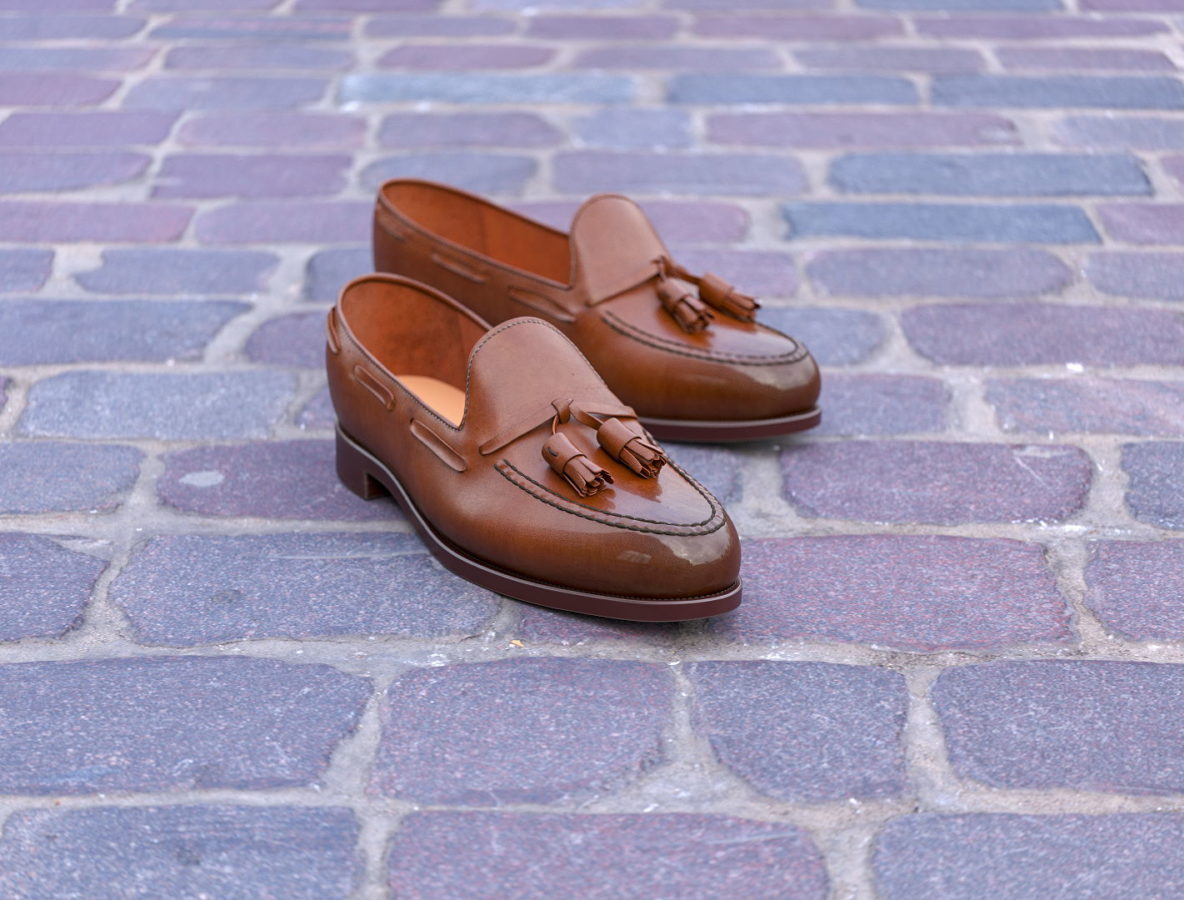
Brown leather tassel loafers, in two settings. Out in the street, the pair stands on purple-grey cobblestones under soft daylight. In the studio they’re on grey, and one shot even has a single loafer floating in mid-air. Both sets come from one model.
What was modeled
A loafer looks like an easy shoe. It isn’t, if you want it to look real. Start with the upper: fine grain in the leather, and a polished shine that gets brighter toward the toe. There’s stitching round the apron and along the welt. The tassels hang off a lace that loops around the collar. And the sole is stacked, so you can see the layers on the heel. We modeled and textured each of those parts on its own. That way light hits the toe, the tassels and the heel the way it would on an actual pair.
Price and timing
On a comparable fashion project, shoes came to about 780 USD and six days. Footwear is at the low end of our fashion range, which starts around 780 USD and six to ten days for a finished piece. Extra work beyond the package costs 20 USD an hour. Two rounds of changes are included. You’ll find the full price picture on our fashion 3D modeling page.
Two sets without two shoots
If you sell shoes, you usually need clean studio shots for the shop and lifestyle pictures for campaigns. Normally that’s two shoots. Or one very long day with a set change in the middle. With a 3D model, we just place the shoes in both scenes. The cobblestones give the loafers a city feel; the studio set shows off the shape. And the floating shot? Hard to pull off in a real studio, since something has to hold the shoe up and then get retouched away. Here it’s only a matter of where we put it.
Colourways
Loafers tend to come in a handful of classic leathers. Tan, dark brown, black, burgundy, now and then suede. Once the model’s built, every one of those is a material change, 1 USD per colourway. Lighting and angles don’t change from one to the next, so the category page stays neat.
People underrate the sole on a shoe. Buyers look at heel height and the welt a lot, and a render from underneath or from the side shows them that. Nobody has to turn a sample over in a studio.
Shoe brands tend to want very particular angles. The classic outside profile. A three-quarter front. The sole. A top view for size charts. With the model done, each of those is just a camera position, and we can render the set for the whole range in one pass. Adding a new leather mid-season? No studio booking, no waiting for a sample pair to show up.
What else the model can do
You can turn the same pair into a 360 spin for the product page, so shoppers get to see the heel and the sole. Export it for AR and customers see the shoe at real size. Or animate a slow turn for social media. With shoes, good visuals cut returns, because people judge shape and colour from a screen. Our article on how realistic 3D models prevent returns explains why.
Let us know if you’ve got an interesting project and want to work together!