About This Project
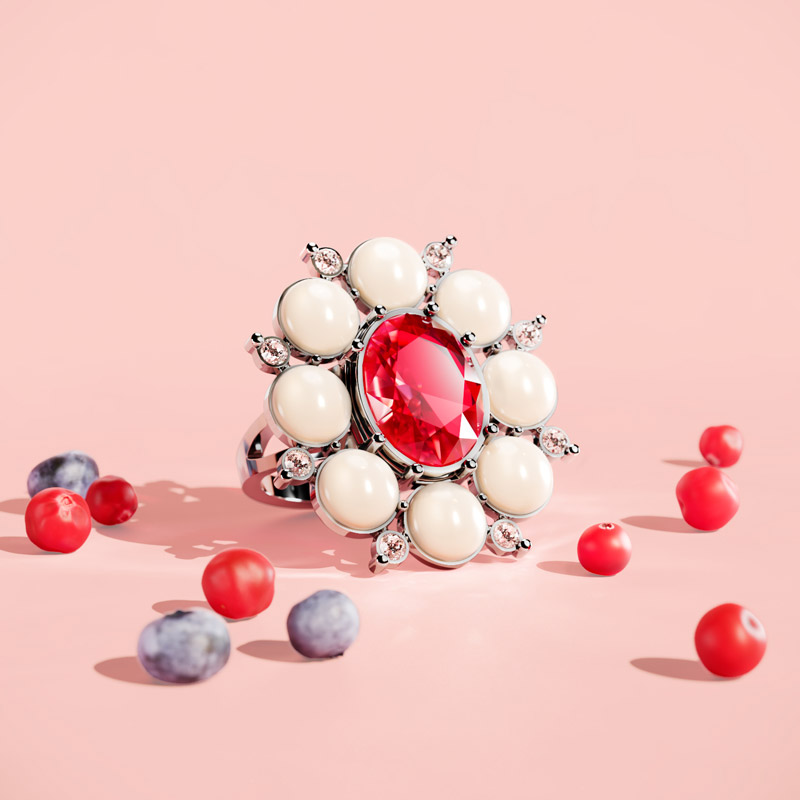
A cocktail ring with a faceted red oval stone in the middle and a halo of round pearls around it. Tiny accent stones fill the gaps between the pearls. You see the ring twice here. Once on a soft pink set with red and blue berries scattered around, and once as a clean angle on white.
Two materials that pull in opposite directions
Pearls and cut stones don’t want the same light. A pearl glows softly, and its sheen rolls slowly over the surface. The faceted red stone is the opposite: it needs hard light, or its facets won’t throw sharp reflections. Photographers usually have to compromise. Either the pearls go flat, or the stone goes dull. In 3D we build each material for what it is. Then we set the lighting so the pearls keep their glow and the centre stone still sparkles. That balance is why the ring looks real.
Price and timing
This ring came to about 480 USD and four days. The pearls are easy shapes. Still, each one has to be the right size and sit in the right spot in the halo. The centre stone and its setting took longer, and the accent stones between the pearls did too. For context, our finished jewelry pieces have ranged from about 400 to 600 USD, from simple pendant earrings up to a pavé brooch. The full list is on our jewelry 3D modeling page.
The pink scene
Look at the berries. They pick up the red of the stone and the round shapes of the pearls, so the props repeat the ring rather than pulling your eye away. The pink keeps it all light and fresh. That’s right for a ring you wear for fun, not for a formal dinner. A set like this for a real photoshoot means sourcing props and keeping fresh berries looking fresh under hot lights. In 3D the berries never wilt.
The shot on white
The second image does the everyday work. Shop pages, marketplace listings and most catalogues need a three-quarter view on white, and this is it. It’s rendered from the same model as the campaign shot. So the stone colour, the pearl sizes and the proportions are identical in both. A customer clicks the ad, lands on the product page and finds the same ring.
About the pearls. Real ones vary in size and tone, even on one strand. Make a halo of perfectly identical spheres and it looks fake. On this ring the pearls differ a little in size and lustre, and that’s why the halo passes for a real piece.
People often buy cocktail rings as gifts. And gift buyers almost never know the ring size. A clear side view helps them here: it shows how high the setting sits, so they can judge if it suits the person they’re buying for.
Variations
It’s an easy design to vary. Swap the centre for a blue sapphire or a green emerald, use white or yellow metal, try another pearl tone. Each of those is a material change on the model we already have. The ring can also be rendered as a 360 spin or animated with a slow light sweep across the stones, which is a common format for jewelry on social media. More on how motion sells jewelry is in our 3D product animation services page.
Let us know if you’ve got an interesting project and want to work together!