
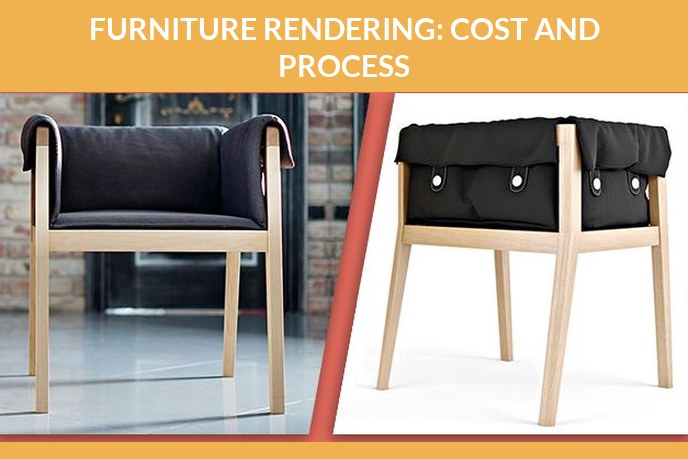
Furniture is the category where 3D rendering makes the most obvious sense and where the quotes make the least. One studio says $80 an image, another says $800, and the brief in both cases was the same sofa. This is what actually drives that number, what a furniture render costs to produce, and when a camera is still the better answer.
The short version. A furniture render on a white background starts at around $20 to $30 an image once the 3D model exists. A full room scene starts around $120 and climbs with styling. The model itself is the one off cost, from $80 for something simple to a few hundred for an upholstered piece with real stitching. Past three or four images per product, or the moment you have fabric options, rendering is cheaper than photography and it never needs the product to exist.
Contents
What furniture rendering is
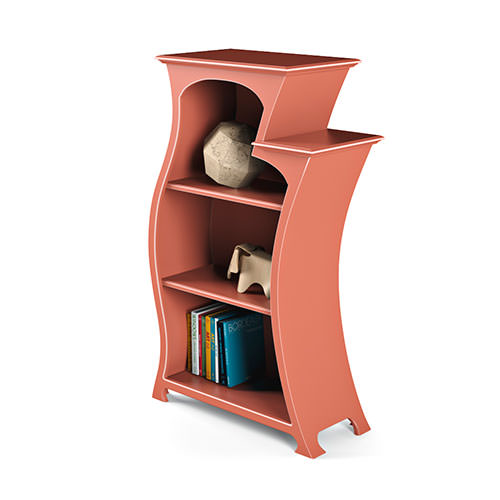
Furniture rendering is the production of photoreal images of a piece of furniture from a 3D model rather than from a camera. The model is built to the manufacturing drawings, dressed in the real materials, lit like a set and rendered out at whatever size the catalogue needs.
You will also see it called furniture visualization or CGI furniture photography. They describe the same work. The distinction that matters is not the name but what is being produced: a silo image on white for the listing, a styled room for the brochure, a spin for the product page, or a full set for a launch.
The reason the category adopted it early is simple. Furniture is large, expensive to ship to a studio, slow to prototype and usually sold in a dozen fabrics. Every one of those facts is a photography problem and a rendering advantage. The models behind every render on this page are built as part of our furniture 3D modeling service, and the piece only has to be modeled once. Where those images earn the most, channel by channel, is mapped in our furniture marketing ideas playbook.
The category is also large enough to justify doing it properly. Statista puts the United States first in furniture ecommerce worldwide, with revenues above 120 billion dollars in 2025. And since the National Retail Federation expects 19.3 percent of online sales to come back in 2025, the images that settle size and colour before the order are not a cosmetic line in the budget.
The shots a furniture catalogue needs
| Shot | Where it is used | What matters |
|---|---|---|
| Silo on white | The listing and the marketplace | One per angle, consistent scale across the range |
| Detail crop | Stitching, joinery, finish, mechanism | The images that justify the price |
| Room scene | Brochure, homepage, social | Styled interior built once and reused across the range |
| Dimension image | Answering the fit question | Reduces returns more than any other frame |
| Variant set | Fabric and finish options | Where rendering pulls decisively ahead of a shoot |
| 360 spin | Product page | From the same model, no turntable needed |
| Animation | Mechanisms, folding, assembly | Sofa beds, recliners, modular systems |
Most brands over invest in room scenes and under invest in the two boring ones: the dimension image and the detail crop. Those are the frames that answer the questions that stop an order. How the white background workhorse is produced, shot or rendered, is unpacked in white background product photography, and rendered spins in 360 product photography.
What furniture rendering costs
| What you are buying | Unit | Typical price |
|---|---|---|
| 3D model of the piece | once per product | from $80 simple, $200 typical, $400 for complex upholstery |
| Render on white | per image | from $20 |
| Render in a full room scene | per image | from $120 |
| Extra fabric or finish variant | per variant | a fraction of a new image, only the material changes |
| 360 spin | per product | from $150 |
| Animation | per second | around $60 |
| AR ready file, GLB and USDZ | per product | included when AR is on the brief |
Why quotes vary so wildly. Four things move the number, and none of them is the render button. Five legitimate ways to bring it down without the images getting worse are collected in product rendering cost.
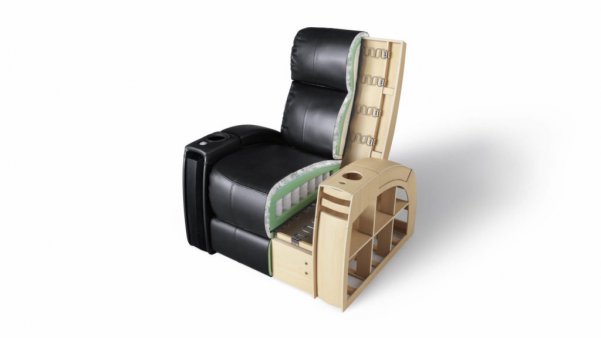
The model. A flat pack side table and a tufted wing chair are not the same job. Buttoning, piping, seams and folds are where the hours go.
The scene. A white background is a lighting setup. A styled living room is set design, props, dressing and a lot of small decisions.
The number of images. The first one carries the setup cost. The fifth is nearly free. Anyone quoting a flat per image rate on a one image job is protecting themselves.
The revisions. Changes at the grey model stage cost minutes. The same change after final lighting costs a day. This is the single biggest avoidable cost on both sides.
Rendering or a photo shoot
| Situation | Photography | Rendering |
|---|---|---|
| Product exists and is in the studio | Straightforward | Needs drawings or a scan first |
| Product is still a drawing | Impossible | Works from CAD, so visuals are ready before production |
| Eight fabrics, three finishes | Eight shoots or a lot of retouching | Swap the material, re render |
| A styled room for every product | Location, props, stylist, day rate | Build the room once, reuse it forever |
| One piece, one image, in a hurry | Usually cheaper | Overkill |
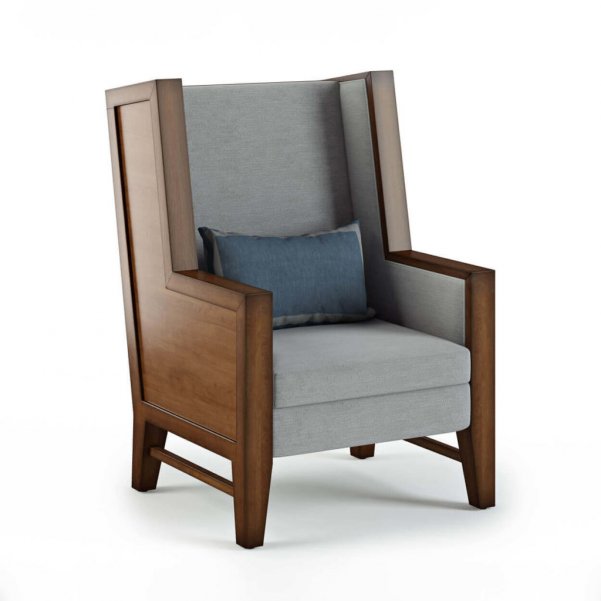
| Fabric texture and drape | Wins on soft, slouchy upholstery | Very good now, but the hardest thing to fake |
| Changing the shot later | Reshoot | Move the camera and re render |
| Consistency across a 200 piece range | Hard and expensive | Native, since the lighting is a file |
The honest version: a single hero shot of one existing sofa is usually cheaper with a camera. A catalogue with variants, a range that changes every season, or a collection that is not manufactured yet is cheaper in 3D, and the gap widens every year the range grows. There is also a logistics line that never makes it into quotes: for a catalogue shoot the furniture has to be manufactured, trucked to a studio, assembled, staged and trucked back, and the calendar bleeds a month before the first spread exists. A rendered catalogue skips the freight entirely, which is why manufacturers courting dealers were among the first to switch.
How a furniture rendering project runs
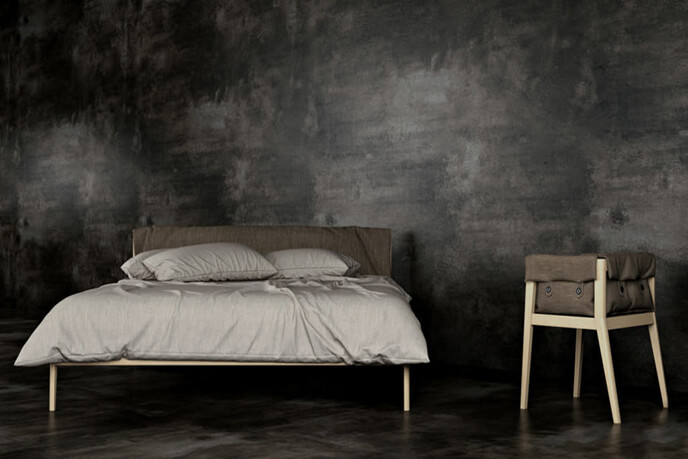
- Brief and references. Drawings or CAD, exact dimensions, material samples or close photographs, and the list of shots.
- Grey model. The geometry, no materials. This is the cheapest moment to say the arm is wrong.
- Materials and lighting. Fabric, wood, metal, and the light that will be reused across the whole range.
- Draft render. Low resolution, for camera angles and composition. Second checkpoint.
- Final render and post. Full resolution, colour corrected, delivered in the sizes you asked for.
Typical turnaround for a single product with a handful of images is a few days once the references are in. What actually delays projects is missing dimensions and material references that arrive as a colour name rather than a photograph.
What separates a good render from a cheap one
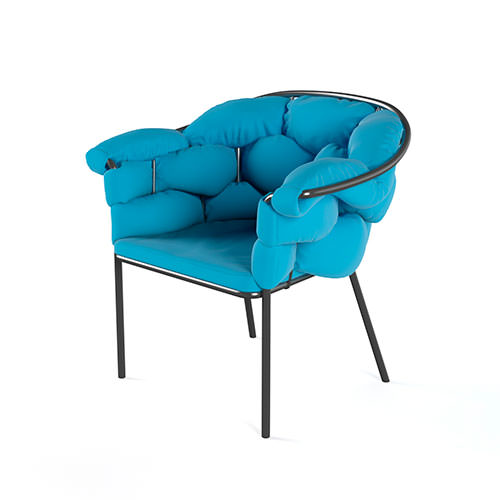
- Fabric that behaves like fabric. Weave visible at close range, seams that follow the form, a cushion that sits with weight in it rather than floating.
- Real dimensions. If the model is not built to the drawings, every image lies about proportion, and the returns follow.
- Contact shadows. The difference between furniture standing on a floor and furniture hovering above one.
- Edges and wear. Perfectly sharp edges read as computer generated. Real furniture has a slightly softened edge on everything.
- Consistent light across the range. Fifty products lit fifty ways look like a marketplace, not a brand.
- Restraint in the scene. If the plant is the most interesting thing in the frame, the render failed.
How to brief it so it comes back right
- Drawings or CAD with real dimensions. A photograph with a tape measure next to it is a poor substitute but better than nothing.
- Material references as photographs of the actual fabric and finish, not colour names. Two brands calling something oatmeal will not agree.
- The shot list, with where each image will be used. A hero for the homepage and a silo for the marketplace are different jobs.
- Reference images you like and one you do not, with a line on why.
- Who approves, and at which stage. Sign off the grey model, then the draft, then the final. Skipping the first two is what makes projects expensive.
On our side the base model is the asset you keep. Once it exists it also produces product rendering for the rest of the catalogue, a spin, product animation for a mechanism, AR product visualization so the buyer can stand the piece in their room, and every product customization variant you decide to add later. The general craft, every shot type and what moves the quote, is in our 3D product rendering guide.
Frequently asked questions
We have been rendering furniture for a decade, from single pieces to full seasonal catalogues. If that is what you need, the details and prices are on furniture 3D modeling, and the wider service is 3D product modeling. Selling on marketplaces as well? Then read Amazon product photography before you commission anything.

Ian Diev
Content Writer, Editor
Ian loves writing about innovative 3D technologies and their impact on architecture and design. In his spare time, he makes indie music, watches obscure movies, and cooks culinary masterpieces for friends.
2 Comments on “FURNITURE RENDERING: WHAT IT COSTS, HOW IT WORKS AND WHEN IT BEATS A PHOTO SHOOT”
Awesome and I really like it. Its a simple info but very important. Thank you.
Wow! great article! l Thank you for sharing Beautiful 3d Furniture modeling.