
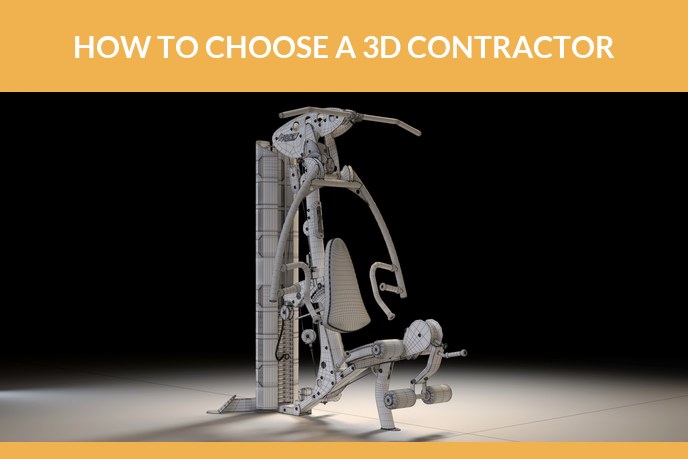
It also helps to know what you are buying in technical terms before the first call, which is what our guide to what 3D modeling is is for.
Contents
- What you are actually buying
- Freelancer, studio or in house
- What 3D modeling companies really charge
- Where to find 3D modeling companies
- How to check a 3D modeling company before money moves
- What to send so the quote is real
- How a project actually runs
- Four things people get wrong
- Red flags when you compare 3D modeling companies
- Frequently asked questions
Comparing 3D modeling companies is a straightforward decision made complicated by the fact that the three options are priced in completely different units. A freelancer quotes an hourly rate, a studio quotes a model, and an in house hire quotes a salary plus everything around it. This page puts all three in the same units so the comparison is honest, whether you end up outsourcing 3D modeling or hiring for it.
What you are actually buying
Not a person and not a department. A finished 3D file that your product photography, your listings, your animation and your AR all come out of afterwards. That distinction matters because it decides what you should be comparing.
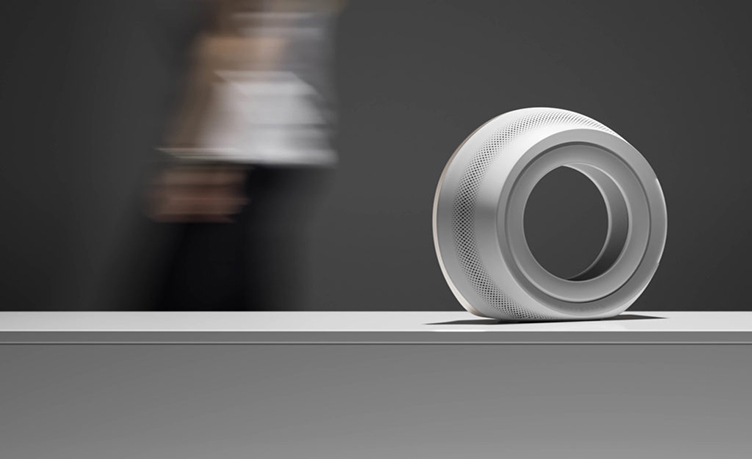
A portable speaker is what the trade calls a typical product: around ten hours of modeling.
An in house modeler is a fixed cost that continues whether or not there is a product to model. Outsourcing converts that into a variable cost tied to actual output. For a brand that launches four products a year, that difference is the whole argument. For a brand releasing something every fortnight, it stops being obvious, and the honest answer may be to hire.
Freelancer, studio or in house
| Freelancer | Studio | In house | |
|---|---|---|---|
| Priced in | Hours | Models or hours | Salary, tools, management |
| Cover if they are ill | None | Another artist | Nobody |
| Scaling up for a launch | Find more people yourself | Already staffed | Hiring cycle |
| Range of skills | One person, one strength | Modeling, materials, render, animation | Whatever you hired for |
| Knows your product line | Learns it | Learns it | Yes, and that is the real advantage |
| Best when | One off job, clear spec | Recurring work, varied output | Constant volume, tight iteration with engineering |
The comparison people usually get wrong is the last row. In house wins on proximity, not on price. If your modeler needs to be in the room with the engineers while the product is still changing shape every week, that is worth paying a salary for. If the product is settled and you need images of it, it is not, and 3D modeling outsourcing is simply the cheaper way to get the same file.
What 3D modeling companies really charge
Freelance rates are public and wider than most people expect. According to published 2026 rate data, junior modelers with up to two years of experience sit at 20 to 40 dollars an hour, mid level at 40 to 75 with an average near 58, senior at 75 to 130, and specialists with ten years or more reach 130 to 220. The full span is 20 to 220 dollars an hour for the same job title.
Add the platform on top. Upwork charges a 5 percent client marketplace fee and takes 10 percent from the freelancer, which is priced into the rate you are quoted whether you see it or not.
For comparison, our own work is billed at 20 dollars an hour, and because the hours are predictable the output is quoted as a fixed number per model:
| What is being modeled | Price | Delivery |
|---|---|---|
| A simple part: a bracket, a stool, a plain enclosure | from $80 | 1 day |
| A typical product: a portable speaker, a pair of earrings | about $200 | 2 to 3 days |
| A complex product: a coffee grinder, a ring with a stone setting | about $400 | 3 to 5 days |
| An ultra complex product: a watch with its movement, a lined jacket | from $1,200 | 7 to 14 days |
The point of showing both is not that one number is smaller. It is that they are not comparable until you convert them. A mid level freelancer at 58 dollars an hour and ten hours of work is a 580 dollar model before platform fees, and you carry the risk of the estimate. The full breakdown of what we charge is on 3D product modeling services.
Where to find 3D modeling companies
Search for 3D modeling companies and the first page is mostly somebody’s ranking of ten of them. Those rankings are worth reading and not worth trusting, because nearly every one is published either by a studio that placed itself at the top or by a directory that sells position. Read them for names, not for order. Here is what each channel actually is.
| Where you look | What you get | What to watch for |
|---|---|---|
| Freelance marketplaces such as Upwork, Fiverr or Cad Crowd | Individuals, quick to start, rates on display | Fees sit on both sides of the deal, and a rating tells you about delivery, not about geometry |
| B2B directories such as Clutch, Sortlist or DesignRush | Studios with verified reviews, team size and past clients | Placement is frequently paid, so sort by reviews rather than by the order on screen |
| Best 3D modeling companies listicles | A fast shortlist of names worth checking yourself | Usually written by one of the companies on the list |
| Studios approached directly | A named contact, an NDA, and work in your product category | No published pricing means the first call has to cover it |
Whichever channel produces the shortlist, the shortlist is where the work actually starts. Two names from a directory and one approached directly, then the six checks below applied to all three, will tell you more than any ranking of ten. Our own answer to the last row is on the UFO3D 3D modeling company page, pricing included.
How to check a 3D modeling company before money moves
Most of the risk in outsourcing 3D modeling is concentrated in the half hour before you agree to anything. Six checks, in the order they save you the most money:
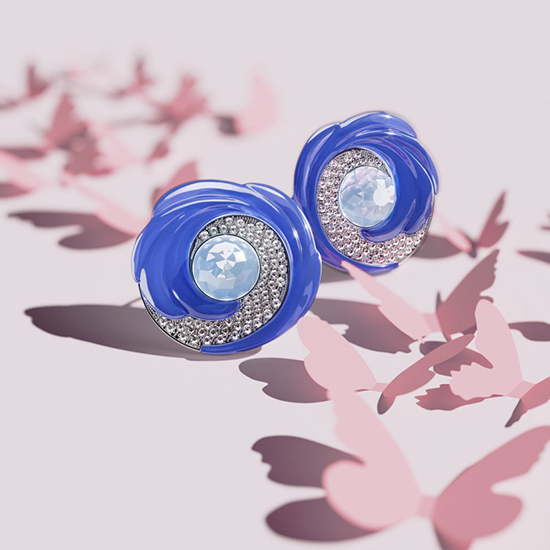
Jewellery is the fastest way to see whether somebody can actually model: small geometry, difficult materials.
- Look at work in your category, not just good work. Someone excellent at characters may never have modeled a hinge. Ask for the closest thing they have done to your product.
- Ask what the source material was. A model built from CAD proves less than the same model built from photographs and a tape measure. The second one is the harder skill and the more common situation.
- Look for the boring things. Fabric, brushed metal, glass, small text on a housing. These are where models fall apart, and portfolios tend to lead with the shapes that are easy.
- Ask to see a grey model. Materials and lighting hide geometry. The untextured version shows whether the object is actually built or just dressed.
- Check what happens when it is wrong. How many rounds of corrections are included, and what counts as a correction rather than a new job. Get this in writing before the first payment, not after the first disagreement.
- Match the scale. One person is right for one model and wrong for two hundred. Ask what the largest batch they have delivered was.
What to send so the quote is real
Vague requests get padded quotes, because the estimate has to cover the worst case. Five things remove the padding:
- The product. CAD if it exists. If not, photographs from several angles in even light, plus dimensions and material names.
- What the model is for. Product images, animation, AR on a phone, 3D printing. Each one implies a different build, and the same model cannot serve all of them without being told in advance.
- How many. Whole ranges are cheaper per unit than single items, because materials and conventions carry over.
- References. Two or three images with the finish and mood you want, and one you dislike with a line on why.
- The deadline you actually have. Not the one you would like. A rush is priced as a rush.
How a project actually runs
- Quote from the brief. If nobody asks you a question at this stage, that is a warning rather than efficiency.
- Grey geometry first. The shape goes to you before any finishing work. This is the cheapest point to change anything and the one clients most often skim.
- Materials and finishes. Now the model looks like the product.
- Renders or export. Images on white, or the file itself in the format your platform needs.
- Corrections. Colour, angle and finish are quick. Changing the geometry at this stage means going back to step two, which is why step two matters.
Four things people get wrong
| The belief | What is actually true |
|---|---|
| Outsourcing means losing control | You approve the geometry before any finishing work. That is more control than most in house processes give you |
| Cheaper means worse | Rate reflects where somebody sits and what they carry in overheads, not how well they model. Judge the portfolio, not the number |
| You need to hand over your CAD | Helpful but not required. Drawings and photographs are the normal starting point, and an NDA covers the rest |
| The model is a one off purchase | It is an asset. Images, 360 spins, animation and AR all come out of the same file, which is where the economics turn |
Red flags when you compare 3D modeling companies
- A quote with no questions. Nobody can price a model they have not understood.
- A portfolio with no grey models and no client names.
- Unlimited revisions. Either it is not true or it is priced in already.
- No named point of contact. On a batch of models, the coordination is most of the job.
- Reluctance to sign an NDA. For anything unreleased this is not negotiable. Before you brief anyone, three of our guides make the conversation easier: how long a 3D model takes, what drives the price and how to check the quality of what you receive. The project itself, stage by stage, is in the 3D modeling workflow.
FAQ
If you are weighing this up right now, the fastest way to get a real number is to send one product with whatever material you have, CAD or photographs, and say where the model has to end up. That is enough to quote properly rather than to guess.

Ian Diev
Content Writer, Editor
Ian loves writing about innovative 3D technologies and their impact on architecture and design. In his spare time, he makes indie music, watches obscure movies, and cooks culinary masterpieces for friends.