
Contents
The problem with every list of VR campaigns
Search for virtual reality marketing examples and the same names come back: Volvo handing out Google Cardboard, Marriott putting headsets in hotel rooms, The North Face dropping shoppers into Yosemite, a newspaper mailing folded cardboard to subscribers.
They are good campaigns. They are also, almost without exception, from 2015 and 2016. Marriott launched VRoom Service and VR Postcards in September 2015. one of the guides still ranking for this phrase still opens with the New York Times Cardboard giveaway and Thomas Cook Try Before You Fly, and supports the case with a statistic sourced to an article from 2015.
That is the single most useful fact about VR marketing, and no listicle says it out loud. The famous campaigns are old because that wave was about the novelty of the headset, and novelty expires. What replaced it is narrower, less photogenic and considerably more profitable.
What those campaigns were actually testing
| Campaign | What it did | What it was really testing |
|---|---|---|
| Volvo Reality | A test drive of an unreleased SUV on Google Cardboard | Whether you can sell a large purchase before the product is in showrooms |
| Marriott VRoom Service | Headsets delivered to a hotel room on request | Whether a destination can be sold by being visited first |
| The North Face | Yosemite and Nepal, in store | Whether an experience in a shop makes the product mean more |
| Newspaper Cardboard giveaways | A viewer posted to subscribers | Whether hardware could be given away cheaply enough to matter |
| Distillery and factory tours | The making of the product, from inside it | Whether process is a story worth telling |
Read the right hand column and the pattern is obvious. Four of the five were testing whether a customer would put a headset on at home. That answer turned out to be no for almost everyone. The fifth was testing something else entirely, and it is the one that still works.
Two of those films are still watchable. Of the other three, one has been taken down and two no longer allow embedding, which is its own comment on the shelf life of a VR campaign.
Coca-Cola turned its Christmas sleigh advert into a VR ride.
The North Face in Nepal, produced with Jaunt for headsets in stores.
What survived the first wave
The formats that lasted have one thing in common: the headset belongs to whoever is running the experience, not to the customer. A trade stand, a showroom, a dealer, a sales meeting. Nobody has to own hardware, install anything or be talked into wearing something at home.
The North Face is a fair illustration. The 2015 in store campaign is the one everybody quotes, and the brand came back to the format in 2021 with a VR and 360 product experience. Not because VR got fashionable again, but because the delivery got easier.
The other survivor is the one nobody calls marketing: the same environment used to sell internally. Design review, dealer training, installation rehearsal. It is the identical build, and it usually pays for itself faster than the campaign does.
Where VR earns its keep for a product brand
| Situation | Why VR beats a video |
|---|---|
| The product is too large to bring to the buyer | Machinery, vehicles, full rooms, production lines. Shipping one to a trade stand costs more than building it in 3D. |
| The product does not exist yet | A buyer can walk through a space or a machine while it is still a drawing. |
| Scale is the selling point | A photograph flattens scale. Standing next to something does not. |
| The buyer has to be trained, not persuaded | Installation, servicing and safety stick better when performed than when watched. |
| The experience is the product | Hospitality, tourism, venues, tours. Here VR is not advertising the thing, it is a sample of it. |
What is missing from that list is ordinary ecommerce. If somebody is holding a phone and deciding between two sofas, VR is the wrong tool and augmented reality is the right one. That comparison is set out in AR vs VR.
What building one actually involves
Here is one of ours, so the process is concrete rather than theoretical. A distillery wanted both photorealistic still images of the space and an interactive walkthrough of it.
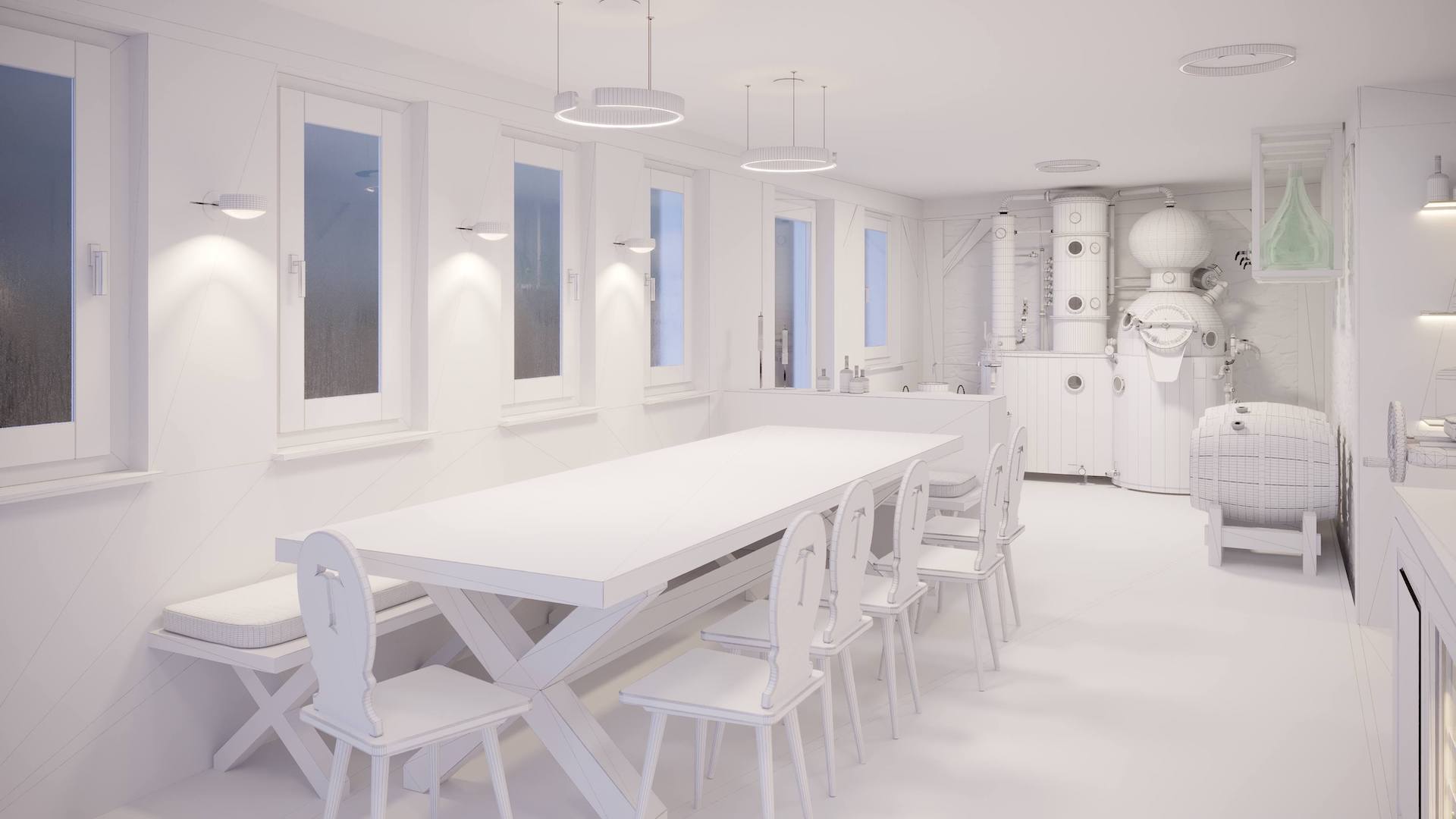
The scene before materials. Everything about the geometry is decided at this stage.
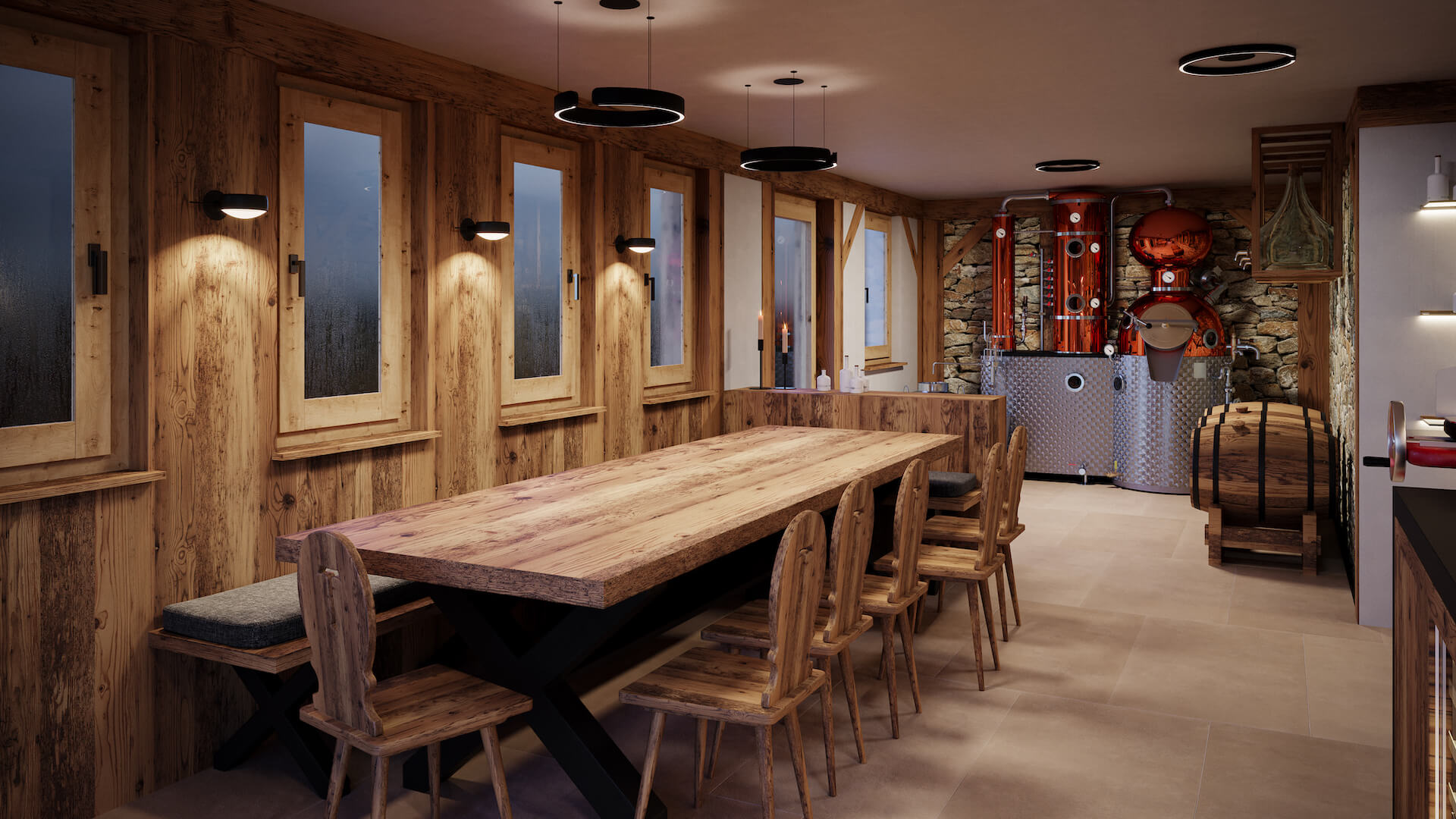
The same camera after texturing, lighting and rendering.
The still images were built as a high poly scene in 3ds Max and rendered with Corona. The VR walkthrough could not use that scene, because a real time engine has to draw the whole room many times a second rather than once. So a low poly version was built from it and taken into Unreal Engine 4.26, targeting an Oculus Rift S.
Inside the engine the work is different in kind from rendering. Lighting is set for real time rather than for a single frame. Navigation points decide where a person can stand. Objects are given the property of being pickable, because the moment that sells a room is always someone reaching for something. An ambient track and object sounds go in last. The client received an executable file they could run themselves.
The same room in the headset: real time, walkable, with objects that can be picked up.
The full breakdown, including the reference material the client supplied and the single revision note we received, is in VR 3D rendering for a distillery.
What it costs and what you supply
Two builds sit inside every VR project, and they are priced separately because they are different work. The environment is modelled once. Making it interactive is a second job on top, and it is the one that varies.
| Stage | What drives the number |
|---|---|
| The 3D environment | Size of the space, number of unique objects, how much of it is bespoke rather than library |
| Real time conversion | Rebuilding the scene to run at frame rate without looking rebuilt |
| Interaction | Walking only is cheap. Picking things up, opening doors, swapping finishes, each one is built |
| Sound | Ambience is quick, object level sound is not |
| Target device | A tethered headset allows more detail than a standalone one. Deciding this late is expensive |
What you send us: the space as drawings or an existing 3D scene, the products that have to appear in it, the device it has to run on, and a list of what a person should be able to do in there. That last item is the one most briefs leave out, and it is the one that sets the price.
When VR is the wrong tool
- The audience is at home on a phone. Use AR. Our AR visualization page covers the model formats that make that work.
- You need reach. VR is a low volume, high intensity format. A hundred people at a stand, not a hundred thousand impressions. Judge it on conversations started, not on views.
- The point can be made in fifteen seconds. A product film is cheaper and travels further. The formats are compared in animated product video.
- Nobody owns the follow up. A headset at a trade show with no one to hand it over and take a name is an expensive toy. Where the calmer sibling earns its keep day after day is in our guide to AR in ecommerce.
FAQ
If you are weighing a VR build, the useful first question is not what it costs but where the headset will physically be. Tell us that, plus what a person should be able to do once it is on, and the rest is straightforward to quote.

Ian Diev
Content Writer, Editor
Ian loves writing about innovative 3D technologies and their impact on architecture and design. In his spare time, he makes indie music, watches obscure movies, and cooks culinary masterpieces for friends.