
Augmented reality stopped being a novelty slot in the media plan somewhere around the point where every phone in the country could run it without installing anything. What is left is a straightforward marketing question: which formats are worth the money, what do they cost, and how do you tell whether one worked.
The short version. AR marketing means letting people point a phone at their room, their face or a printed surface and see something that is not there. The formats that survive are the useful ones: try before you buy, see it at true scale, unlock something on the pack. Most of the budget goes into the 3D content, not the technology, and the same asset keeps working on the product page long after the campaign ends.
Contents
What augmented reality marketing is

Augmented reality marketing is any campaign or brand experience where digital content is placed into the customer view of the real world, usually through the camera on their own phone. The product appears in their living room, the lipstick appears on their face, the character climbs out of the cereal box.
You will also see it called AR advertising. The two overlap but are not identical: AR marketing covers the whole discipline, including things that live permanently on a product page, while AR advertising usually means a paid placement, a social ad unit or a lens you promote for a fortnight.
The important shift is that the barrier is gone. WebAR runs in the mobile browser, so a QR code on a poster or a button on a page opens the experience with nothing to install. Ten years ago every campaign needed an app download, which is why most of them failed.
The scale is no longer marginal either. Statista counts roughly 1.07 billion mobile AR users in 2025, heading for 1.19 billion by 2028, which means the audience for a campaign that opens a camera is now most of the smartphone owning population. What that audience actually does in stores is in our AR statistics for ecommerce.
The formats that actually get used
| Format | What happens | Who it suits |
|---|---|---|
| Try it on | Face, wrist, feet | Glasses, cosmetics, watches, jewellery, trainers |
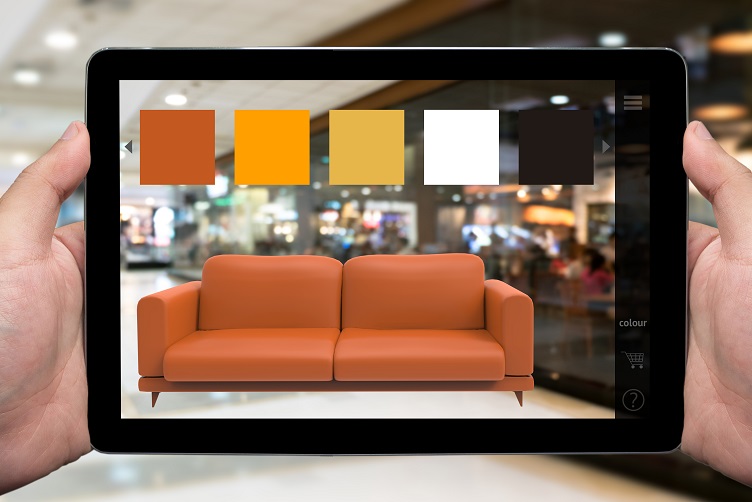
| See it in the room | True scale placement | Furniture, appliances, decor, anything large |
| Packaging AR | Camera on the pack unlocks content | FMCG, drinks, toys, limited editions |
| Print and outdoor | Poster, catalogue or bus shelter as the trigger | Retail, events, brand stunts |
| Social lenses and filters | Snap, TikTok and Instagram effects | Reach campaigns, launches, younger audiences |
| In feed AR ads | Paid units that open the camera | Performance campaigns with a product to show |
| Location based | Content tied to a place | Retail footfall, tourism, events |
Two of these do the commercial heavy lifting for product brands: try it on and see it in the room. Both answer a question the shopper already has, which is why they keep working after the campaign budget stops. The rest are attention formats, and they should be judged as attention formats.
The types of AR, in plain terms
| Type | How it is triggered | Typical use |
|---|---|---|
| Marker based | A printed image, logo or pack triggers the content | Packaging, print ads, business cards |
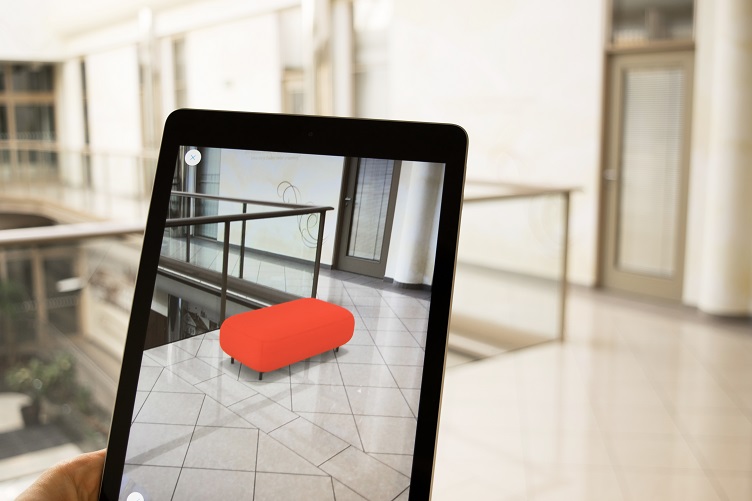
| Markerless | The phone reads the surface and places the object | Furniture and appliances in a room |
| Location based | GPS or beacons tie content to a place | Store campaigns, city trails, events |
| Superimposition | The object replaces or overlays what the camera sees | Try on, before and after |
| Projection | Light is projected onto a real surface | Installations and events, not phones |
For most brands the choice is between the first two. Marker based needs a printed thing in the wild, which makes it good for packaging and posters. Markerless needs nothing but a floor, which is why it is the default for ecommerce.
Campaigns worth copying
- IKEA Place. Furniture at true scale on your floor, launched on ARKit in 2017. Still the reference for the format, because it solved a real problem rather than showing off.
- L Oreal Makeup Genius. Makeup mapped onto the face in real time, years before it was easy. It turned a browsing session into a fitting.
- Pepsi Max, the bus shelter. A screen in a London bus shelter showed tigers and meteors arriving down the street. Pure attention, no product utility, and it worked because the setting was unexpected.
- Burger King, Burn That Ad. Point the app at a competitor poster, watch it burn, get a free burger. Media budget turned into a mechanic.
- Nike SNKRS Cam. AR used as the door to a drop, tying the experience to scarcity rather than to novelty.
- Gucci try on. Shoes and glasses fitted through the app and through Snap, aimed at exactly the audience that lives in the camera.
- Amazon View in Your Room. Not a campaign at all, a permanent feature. The unglamorous version of AR marketing, and the one that sells the most.
The pattern behind the ones that lasted: they either removed a doubt about the product or gave people a reason to point a camera at something they were already looking at. The ones that did neither are gone.
Where it pays off for product brands
Some categories get a return from AR quickly, and they have something in common: the buyer has a question that a photograph cannot settle.
- furniture and appliances. Will it fit, and will it clash with the room. This is where AR earns its keep, and where returns fall when the answer arrives before the order.
- jewelry and watches. Scale on a real hand or wrist. Photographs of small products lie about size constantly.
- Beauty and eyewear. Face tracking is mature, and the try on has become an expected feature rather than a campaign.
- Anything sold on Amazon listings. View in Your Room runs on a 3D model supplied to the marketplace, so the same asset serves the campaign and the listing.
The thing to plan for is what happens after the campaign. A lens that runs for two weeks is a cost. A model that then lives on the product page, feeds the renders and opens in AR from the listing is an asset. Same production, very different accounting.
What it costs and what you need
Split the budget into two piles before anyone quotes you. The content pile is the 3D asset and its exports. The platform pile is the lens, the viewer or the app that delivers it. Agencies often quote them together, which hides where the money goes.
| What you are buying | Unit | Typical price |
|---|---|---|
| 3D model of the product | once, then reused everywhere | from $80 simple, $200 typical, $400 complex |
| AR ready export, GLB and USDZ | per product | included when AR is on the brief |
| Renders and a spin from the same model | per output | from $20 per image, from $150 per spin |
| Social lens or filter build | per effect | quoted by the studio or platform partner |
| WebAR hosting and viewer | per month | platform fee, depends on the vendor |
| Media to promote it | campaign | the usual media maths, unrelated to the content |
We sit in the first pile: accurate models, correct materials, real dimensions, and files that open on both phone platforms. The second pile depends on where the campaign runs, and it changes faster than anything else in this field.
How to tell whether it worked
| Metric | What it measures | What it is worth |
|---|---|---|
| Opens or scans | How many people started it | Tells you the placement worked, not the experience |
| Dwell time | Seconds spent in AR | The honest engagement number |
| Interaction depth | Colours tried, angles viewed, variants opened | The one that predicts purchase |
| Add to cart after AR | Behaviour, not attention | The number worth reporting |
| Return rate on AR enabled products | Compared with the rest of the range | Slow to read, but it is where the money is |
Impressions are the metric everyone reports and the one that means least here, because AR only starts when somebody deliberately opens the camera. Agree before launch which two numbers decide whether it was worth repeating.
Mistakes that waste the budget
- Requiring an app download. The single biggest reason campaigns underperform, and completely avoidable now that WebAR exists.
- A QR code with no reason to scan it. The code is not the offer.
- A one off stunt with no asset left behind. Two weeks of reach, nothing on the product page afterwards.
- A model that flatters the product. It converts, then it comes back as a return.
- Building everything on one vendor platform. Meta closed its Spark effects platform in 2025 and took a lot of brand lenses with it, which is a reasonable argument for keeping your own models in open formats.
- No fallback. Older devices and locked down browsers exist, so there has to be a video or a spin behind the AR button.
- Launching in a category where the buyer has no question. AR on a paperback is a gimmick.
We make the part of this that outlives the campaign: 3D product modeling of your products, correct at real dimensions, exported for AR on both phone platforms. Start with augmented reality product visualization, or read how AR works on a product page if you want the mechanics first.
Frequently asked questions

Ian Diev
Content Writer, Editor
Ian loves writing about innovative 3D technologies and their impact on architecture and design. In his spare time, he makes indie music, watches obscure movies, and cooks culinary masterpieces for friends.