About This Project
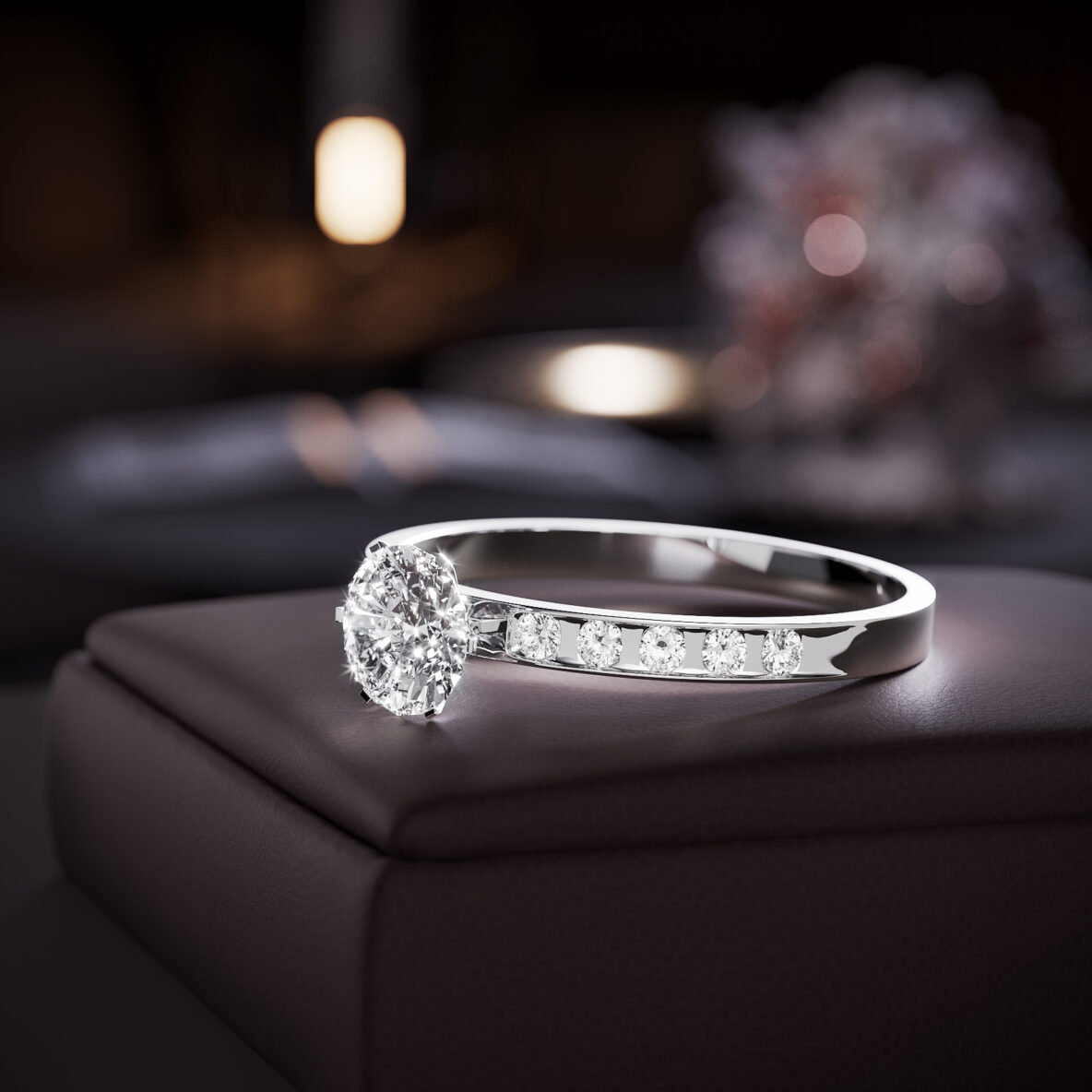
Here’s a classic solitaire engagement ring, the kind with a single round diamond held up by claws. The band is slim, and there are small stones set along its shoulders. It’s sitting on top of a dark velvet box, and behind it you’ve got warm lights, all out of focus. You’d put an image like this at the top of a product page, or use it to open an engagement collection.
Why the diamond takes the most time
With a solitaire there’s nowhere to hide. The centre stone is the whole reason anyone looks, so it’s got to behave like an actual diamond: bright, throwing hard white sparks and tiny bits of colour. For that, every facet needs its proper angle, and the material has to refract light correctly. If the stone’s modeled sloppily, it comes out looking like a piece of glass. Is the pavé on the band any easier? Yes, a bit. Each of those little stones is still its own object though, so each one catches the light on its own.
The setting and the band
Claws are tricky: thin enough to look elegant, thick enough that the stone looks safe. We also modeled the gallery under the stone, the bit you see from the side, since that’s the view buyers zoom into. The band narrows a little toward the back. The shoulder stones shrink as they go. Small stuff, sure. But it’s what decides whether a render can pass for a photo.
The scene
What’s the velvet box and the bokeh for? Mood. It feels like evening, warm and a bit romantic, which is pretty much what engagement jewelry is sold on. We blurred the background on purpose, so your eye goes right to the stone. Need a clean shot on white for the shop and the marketplace? Same model. One more camera, one more render, and no new project.
Price and timing
A ring with a stone setting usually comes to around 400 USD for the model. Our finished jewelry pieces have landed between about 400 and 600 USD, taking three to five days. A plain band with no stones is nearer 200. Billing is 20 USD an hour, and you approve the grey model before any materials go on. Two rounds of changes are included. For the full price picture, see our jewelry 3D modeling page.
One more thing about diamonds. In a render, the colour of the stone is a choice. It can go from icy white to slightly warm, and it needs to match the way the brand grades and describes its stones. That setting is stored in the material, so it stays the same in every image of the ring.
From one ring to a range
Engagement rings normally come in several metals and stone sizes. Once there’s a model, each of those is just a variation of the same file. White, yellow or rose gold. A bigger or smaller centre stone. A plain band in place of pavé. Since the lighting and camera don’t change, the whole range looks consistent. Want a 360 view or an AR file? We can do that from the same ring, so a buyer gets to see it at real size before they order.
Curious what a studio needs from a jewelry brand before it can start? Our 3D modeling cost and timeline guide goes through it, including how the input you send changes the price.
Let us know if you’ve got an interesting project and want to work together!